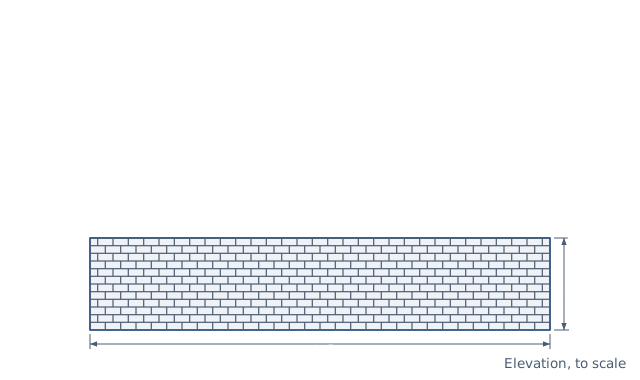
Drawn for the default inputs. It redraws as you change them.
Results are estimates. They do not replace the governing code, class or flag requirements, or a check by a competent person. Report a problem
Introduction
How many concrete blocks do you need? Divide the wall area by the face of one block plus its joint. A standard 8 × 16 in block covers 0.889 ft², so each square foot of wall takes 1.125 blocks. A wall 40 ft long and 8 ft high has 320 ft² and needs 360 blocks, or 378 with 5 % for breakage.
This calculator counts the blocks for a wall after deducting doors and windows, and adds the waste allowance. It estimates the bags of mortar mix and, for US hollow blocks, the grout to fill the cores at the spacing you choose. It is for masons, contractors and homeowners planning a garden wall, foundation wall or retaining wall.
Formulas
Blocks:
A_net = L × H − openings
blocks = A_net / (face length × face height) × (1 + waste)
Mortar and grout:
bags = blocks / 16
grout = A_net × g / 100
L, H — wall length and height; openings — area of doors and windows
face — nominal block face including one joint: 16 × 8 in (0.889 ft²) or 450 × 225 mm (0.101 m²)
16 — blocks laid per 80 lb bag of preblended mortar with face-shell bedding (NCMA TEK 4-2A Table 2)
g — grout in ft³ per 100 ft² of wall from NCMA TEK 4-2A Table 3
Grout per 100 ft² of wall, two-core hollow units, 3 % waste included:
Cores grouted
6 in wall
8 in wall
10 in wall
12 in wall
Every core
25.6 ft³
36.1 ft³
47.0 ft³
58.9 ft³
16 in on centre
12.8 ft³
18.1 ft³
23.5 ft³
29.5 ft³
24 in on centre
8.6 ft³
12.1 ft³
15.7 ft³
19.7 ft³
32 in on centre
6.4 ft³
9.1 ft³
11.8 ft³
14.8 ft³
48 in on centre
4.3 ft³
6.1 ft³
7.9 ft³
9.9 ft³
Assumptions and limitations
The wall is a single wythe in running bond. Corner, lintel and bond-beam units are counted as ordinary blocks.
A US block is 15⅝ × 7⅝ in actual, laid with ⅜ in joints to an 8 × 16 in module. A metric block of 440 × 215 mm with 10 mm joints fills 450 × 225 mm.
The mortar rate of 16 blocks per bag is the NCMA figure and includes normal waste. The QUIKRETE Mortar Mix data sheet gives 13 blocks per 80 lb bag, so enter 13 for a cautious estimate.
Grout volumes come from NCMA tables for two-core units. Bond beams and larger cells need more. Grout is not estimated for metric blocks.
A wall that retains soil or carries a building needs reinforcement and an engineer's design.
Worked example
A wall is 40 ft long and 8 ft high, built of 8 in hollow blocks with no openings. The cores are grouted at 48 in on centre. How many blocks, bags of mortar and how much grout are needed with 5 % waste on the blocks?
Wall area: 40 × 8 = 320 ft².
Blocks: 320 / 0.889 = 360 blocks, in 12 courses of 8 in.
With 5 % waste: 360 × 1.05 = 378 blocks.
Mortar: 360 / 16 = 22.5, so 23 bags of 80 lb mortar mix.
Grout: 320 × 6.1 / 100 = 19.5 ft³, which is 0.723 yd³.
At the QUIKRETE rate of 13 blocks per bag the mortar would be 28 bags. Order the grout as about three-quarters of a cubic yard of ready-mix grout, or mix it on site.
The worked example, drawn by the same code as the live drawing above.
FAQ
How many blocks are in a square foot?
1.125 standard 8 × 16 in blocks per square foot, or 112.5 per 100 ft² before waste.
How many blocks per square metre?
9.88 metric blocks of 440 × 215 mm with 10 mm joints, before waste.
How many bags of mortar for 100 blocks?
About 6.3 bags of 80 lb preblended mortar at the NCMA rate of 16 blocks per bag, or 7.7 at the QUIKRETE rate of 13.
How much grout fills an 8 in block wall?
36.1 ft³ per 100 ft² when every core is filled, about 0.32 ft³ per block. Grouting every third core at 24 in takes 12.1 ft³ per 100 ft².
What are the actual dimensions of an 8 × 8 × 16 block?
7⅝ × 7⅝ × 15⅝ in. The ⅜ in mortar joint brings it to the 8 × 16 in module.
How much waste should I allow?
About 5 % for breakage and cutting on a plain wall. Allow more for many corners, piers and openings.
Before every release the calculator must reproduce each case below. The note under each case says where the expected answer comes from: a standard, a textbook, a published table, or a hand calculation shown in full.
40 × 8 ft wall of 8 in blocks grouted at 48 in: 360 blocks, 378 with 5 % waste, 23 bags, 19.5 ft³ = 0.723 yd³ of groutHand calculation: 320 ft² / (16 × 8 / 144) = 360; 360 / 16 per bag = 22.5 → 23; TEK 4-2A Table 3: 6.1 ft³ per 100 ft²
NCMA TEK 4-2A Table 3, solid grouted per 100 ft²: 6 in 25.6 ft³, 8 in 36.1, 10 in 47.0, 12 in 58.9; 12 in at 32 in o.c. 14.8NCMA (CMHA) TEK 4-2A, Estimating Concrete Masonry Materials, Table 3 (two-core units, 3 % waste)
One block covers 0.889 ft², so 100 ft² takes 112.5 blocks (113); NCMA rate of 16 blocks per 80 lb bag gives 8 bags per 128 blocksNCMA TEK 4-2A: 8 × 16 in face = 8/9 ft² per unit; Table 2: one 80 lb bag of preblended mortar lays 16 conventional CMU
Metric 440 × 215 mm blocks: 9.88 per m², 10 × 2.25 m wall = 223 blocks, no grout estimate; openings are deductedHand calculation: 1 / (0.45 × 0.225) = 9.877 per m²; 22.5 × 9.877 = 222.2 → 223
Openings as large as the wall, zero length and an unknown width are rejected; an off-module height warnsBehaviour check: warnings and rejected inputs
Worked example of the article: the calculator reproduces 360, 378, 23, 19.5 ft³, 0.723 yd³ to the digits printedThe worked example on this page, to the digits printed
Assumptions and sources
Assumptions and limits
Single-wythe wall laid in running bond. The count uses the face module of the unit plus one joint: 8 × 16 in (0.889 ft²) for US blocks and 225 × 450 mm (0.101 m²) for metric blocks. Corners, lintels and bond beams need their own special units.
Mortar uses the NCMA estimate of 16 conventional blocks per 80 lb bag of preblended mortar with face-shell bedding, which includes nominal waste; the QUIKRETE Mortar Mix data sheet gives 13, so use that rate for inexperienced masons. Metric blocks are scaled by their longer joint length.
Grout volumes are those of NCMA TEK 4-2A Table 3 for two-core hollow units, including 3 % waste; units with larger cells or bond beams take more. Grout is not estimated for metric blocks, which are often solid or have other cell shapes.
The waste allowance on blocks covers breakage and cuts; NCMA uses about 5 %.
Sources
NCMA (CMHA) TEK 4-2A, Estimating Concrete Masonry Materials: Table 2 (mortar, 16 units per 80 lb preblended bag) and Table 3 (grout volume per 100 ft² of wall)
QUIKRETE Mortar Mix No. 1102 data sheet (an 80 lb bag lays up to 13 standard 8 × 8 × 16 in blocks)
Cite this calculator
Papandreou, C. (2026). Concrete block calculator: CMU, mortar and grout. Engineering Bible. https://engineeringbible.com/civil/concrete-block/
Embed this calculator on your site
Copy this HTML into your page. The calculator stays free to use and links back here.