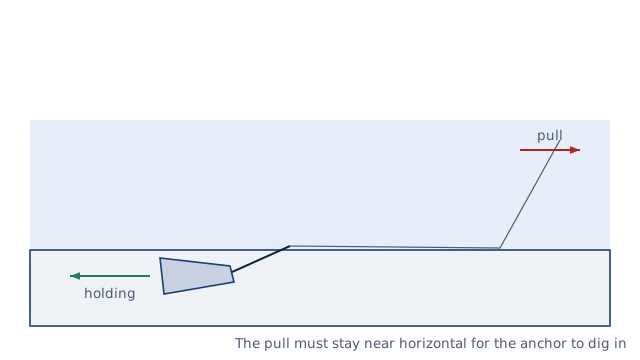
Drawn for the default inputs. It redraws as you change them.
Results are estimates. They do not replace the governing code, class or flag requirements, or a check by a competent person. Report a problem
Introduction
An anchor's holding power is its weight multiplied by its efficiency, the number of times its own weight it can hold before it drags. Efficiency depends on the anchor design and the seabed. The Vryhof Anchor Manual groups drag anchors into classes, from about 4 to 6 for stockless ship anchors up to 33 to 55 for modern high-penetration designs. A 6 t stockless anchor at an efficiency of 4 holds about 24 tonnes-force, or 235 kN.
This calculator gives the holding capacity of an anchor from its mass and class, and the allowable force after a safety factor. It also works backwards to the anchor mass needed for a design force. It is the companion of the anchor catenary calculator, which gives the force the cable brings to the anchor. It is for ship officers, mooring designers and boat owners choosing an anchor.
Formulas
Holding capacity and allowable force:
H = η × W × g
F_allow = H / SF
Size effect from Vryhof's holding-capacity charts (UHC = A W^0.92):
H = η × W_ref g × (W / W_ref)^0.92, W_ref = 10 t
Anchor mass for a design force F:
W = F × SF / (η g)
Efficiencies η by Vryhof class, for a 10 t anchor:
Class A, 33 to 55 — Stevpris, Stevshark, FFTS
Class B, 17 to 25 — Bruce SS, Bruce TS, Hook
Class C, 14 to 26 — Stevin, Stevfix, Stevmud, Flipper Delta
Class D, 8 to 15 — Danforth, LWT, Moorfast, Stato, Offdrill, Boss
Class E, 8 to 11 — AC14, Stokes, Snugstow, Weldhold
Class F, 4 to 6 — US Navy stockless, Beyers, Union, Spek
Assumptions and limitations
The efficiencies apply to an anchor that has dug in fully with the line horizontal at the seabed. Any uplift of the cable at the shank reduces the holding sharply.
The seabed matters. Holding is highest in sand and stiff clay and lower in very soft mud, where the fluke angle should be about 50°. On rock or weed an anchor may hardly hold at all.
The low end of each range is used by default. Use the middle or high end only with good reason, such as test results in similar soil.
The class figures come from offshore anchors around 10 t. For small boat anchors they are only a guide.
Worked example
A ship has a 6 t stockless anchor. What holding power can it be counted on for, with a safety factor of 1.5?
Class F, low end of the range: η = 4.
Holding capacity: 4 × 6 t = 24 tonnes-force, which is 24 000 × 9.81 = 235 kN.
Allowable force: 235 / 1.5 = 157 kN.
The other way round: holding 300 kN with the same factor needs 300 × 1.5 / (4 × 9.81) = 11.5 t of stockless anchor, or 5.7 t of a Class D anchor at η 8.
The worked example, drawn by the same code as the live drawing above.
FAQ
How do I calculate anchor holding power?
Multiply the anchor's weight by its efficiency for the seabed. A 6 t stockless anchor at η 4 holds about 24 t, or 235 kN.
What is a high holding power anchor?
Under the IACS rules on anchoring equipment, an HHP anchor must hold at least twice as much as an ordinary stockless anchor of the same mass. Classes A to D are all well above stockless anchors.
How much will a small boat anchor hold?
By the Class D range, a 15 kg Danforth-type anchor holds 120 to 225 kgf, 1.2 to 2.2 kN. Small anchors in good sand often do better, and much worse in weed or soft mud.
What safety factor should I use?
API RP 2SK uses 1.5 for drag anchors of permanent moorings in the intact condition with a dynamic analysis. A ship at anchor relies on paying out more cable and on its engines, but a margin above the expected force is still prudent.
Why does my anchor drag when the numbers say it should hold?
The cable may lift at the shank, the anchor may not have dug in, the seabed may be poor, or yawing and snatching may double the static load. Check the scope with the catenary calculator.
Does a heavier anchor always hold more?
Yes, but less than in proportion. Vryhof's charts follow weight to the power 0.92, so twice the mass gives about 1.89 times the holding.
Before every release the calculator must reproduce each case below. The note under each case says where the expected answer comes from: a standard, a textbook, a published table, or a hand calculation shown in full.
6 t stockless anchor (Class F, η 4): holding 24 tf = 235.4 kN, allowable 156.9 kN at a safety factor of 1.5Vryhof Anchor Manual (2000), Class F efficiency 4–6; hand calculation
Class ranges: a 10 t Class A anchor holds 33 to 55 times its weight; Class D middle is 11.5Vryhof Anchor Manual (2000), "Characteristics of anchor types" (efficiency for a 10 t anchor)
Required mass: 300 kN with SF 1.5 needs 450 / (4 × 9.80665) = 11.47 t of Class F, 5.74 t of Class D at η 8W = F SF / (η g); hand calculation
Vryhof size law UHC ∝ W^0.92: equal to the linear rule at 10 t; a 20 t anchor holds 2^0.92 = 1.892 times a 10 t one; inverse round tripVryhof Anchor Manual (2000), UHC = A W^0.92 charts; consistency check
Small anchors warn; a safety factor below 1 and a zero mass are rejectedBehaviour check: warnings and rejected inputs
Worked example of the article: the calculator reproduces 235 kN, 157 kN to the digits printedThe worked example on this page, to the digits printed
Assumptions and sources
Assumptions and limits
Holding capacity = efficiency × anchor weight in air. The efficiency ranges by anchor class are those of the Vryhof Anchor Manual, quoted for a 10 t anchor fully embedded in good holding ground with the line horizontal at the seabed.
The low end of the range is used by default. Holding is highest in sand and stiff clay and lower in very soft clay (mud), where the fluke angle must be set to about 50°; it can be close to nothing on rock, weed or a fouled anchor.
Vryhof's holding-capacity charts follow UHC = A W^0.92, so efficiency falls slowly as anchors get bigger. The size-scaled option applies that law from the 10 t reference size; the linear option keeps the efficiency constant, which is conservative for anchors smaller than 10 t.
Any uplift of the line at the anchor shank reduces the holding sharply: check the scope with the anchor catenary calculator. Dynamic loads from yawing and snatching in a seaway come on top of the static force.
The safety factor divides the holding capacity. API RP 2SK uses 1.5 for drag anchors of permanent moorings in the intact condition with a dynamic analysis; ship anchoring relies on paying out cable and on the engine instead.
Sources
Vryhof Anchors, Anchor Manual 2000 (Krimpen a/d IJssel), "Characteristics of anchor types" (classes A–G, efficiency for a 10 t anchor) and the UHC = A W^0.92 holding-capacity charts
API RP 2SK, Design and Analysis of Stationkeeping Systems for Floating Structures, 3rd ed. (2005): factors of safety for drag anchor holding capacity
IACS UR A1, Anchoring equipment: high holding power anchors with at least twice the holding power of an ordinary stockless anchor of the same mass
Cite this calculator
Papandreou, C. (2026). Anchor holding power calculator. Engineering Bible. https://engineeringbible.com/maritime/anchor-holding/
Embed this calculator on your site
Copy this HTML into your page. The calculator stays free to use and links back here.