Gravity drain and sewer pipe sizing by Manning: full-flow capacity and velocity, smallest standard diameter for a flow, flow depth and self-cleansing check.
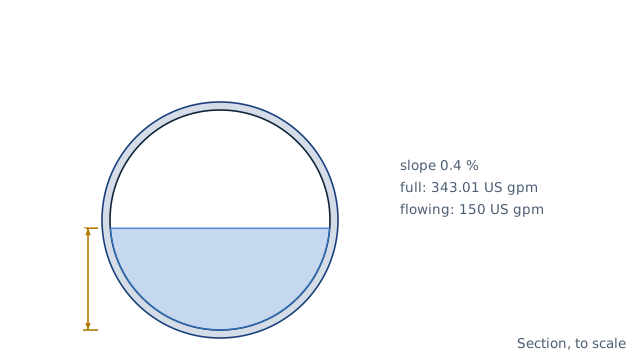
Drawn for the default inputs. It redraws as you change them.
Results are estimates. They do not replace the governing code, class or flag requirements, or a check by a competent person. Report a problem
Introduction
How do you size a gravity drain pipe? Use Manning's equation to find how much the pipe carries when it flows full at its slope, and choose the smallest standard size that carries the design flow. An 8 in concrete sewer laid at 0.40 % carries 343 US gallons per minute at 2.19 ft/s when full. That velocity meets the usual rule of at least 2 ft/s, which keeps solids moving.
This calculator gives the full-flow capacity and velocity of a pipe from its diameter, material and slope. It finds the smallest standard size for a design flow, and the depth and velocity of that flow in the chosen pipe. It also checks the self-cleansing velocity and gives the minimum slope that reaches it. It is for civil engineers, site designers and contractors laying storm drains, sewers and land drains.
Formulas
Manning's equation for a pipe flowing full:
V = (1/n) × R^(2/3) × S^(1/2)        (SI, metres)
V = (1.486/n) × R^(2/3) × S^(1/2)    (US, feet)
Q = A × V,  A = π D² / 4,  R = D / 4
Part-full pipe at depth y, and the minimum slope:
θ = 2 acos(1 − 2y/D)
A = D² (θ − sin θ) / 8,  P = D θ / 2,  R = A / P
S_min = (n × V_min / R^(2/3))²
D — inside diameter; S — slope as a fraction, 1 % = 0.01
n — Manning roughness: 0.009 for smooth PVC, 0.013 for concrete and clay, and for any pipe where the agency requires it
V_min — self-cleansing velocity, 2.0 ft/s (0.61 m/s) flowing full
A, P, R — flow area, wetted perimeter and hydraulic radius
Assumptions and limitations
Flow is steady and uniform in a straight pipe of constant slope. Manhole losses, bends, backwater and surcharge are not included.
Smooth PVC tests at n = 0.009, but many agencies require 0.013 for every material to allow for joints and slime. Use the value your reviewer accepts.
The nominal size is used as the inside diameter. Plastic sewer pipe is often slightly smaller inside, so enter the true bore for a close check.
The self-cleansing check follows the Ten States Standards, which want at least 2.0 ft/s with the pipe flowing full.
Building drains are sized by the plumbing code with drainage fixture units. Those tables are not reproduced here.
Worked example
An 8 in concrete sewer is laid at 0.40 % with n = 0.013. What does it carry flowing full, and how deep does a design flow of 150 US gpm run?
Capacity: 0.349 × 2.19 = 0.764 ft³/s, which is 343 US gpm.
Self-cleansing: 2.19 ft/s is above 2.0 ft/s, so the slope is adequate.
Design flow: 150 / 343 = 44 % of the full capacity.
Depth by Manning's equation on the part-full section: y/D = 0.46, or 3.7 in.
Velocity at that depth: 2.12 ft/s.
A 6 in pipe at the same slope would carry 159 gpm full, just enough for 150 gpm. Public sewers are usually at least 8 in, which also leaves room for peak flows.
The worked example, drawn by the same code as the live drawing above.
FAQ
What is the minimum velocity in a sewer?
2.0 ft/s, or 0.61 m/s, with the pipe flowing full, by the Ten States Standards. Lower velocities let grit and solids settle.
What slope does an 8 in sewer need?
The Ten States Standards ask for at least 0.40 % with n = 0.013. Manning's equation gives 2 ft/s at 0.334 %, so the table keeps a margin.
How much does a 4 in PVC drain carry?
At ¼ in per foot, 2.08 %, a 4 in pipe with n = 0.009 carries about 178 US gpm flowing full at 4.55 ft/s.
What Manning's n should I use for PVC pipe?
0.009 for smooth-wall PVC by Uni-Bell tests, but many agencies require 0.013 for all materials. Corrugated pipes are much rougher.
Why does a pipe carry most at about 94 % depth?
Near the crown the wetted perimeter grows faster than the area, so friction rises. The free-surface flow peaks near 94 % depth at about 1.08 times the full-pipe flow.
Why is the velocity at half depth the same as full?
At half depth the hydraulic radius is D/4, the same as for the full pipe. The velocity is equal and the flow is exactly half.
Before every release the calculator must reproduce each case below. The note under each case says where the expected answer comes from: a standard, a textbook, a published table, or a hand calculation shown in full.
8 in at 0.40 %, n 0.013: 0.764 ft³/s (343 US gpm) at 2.19 ft/s flowing fullHand calculation, US Manning: Q = 1.486/0.013 × 0.3491 ft² × (0.1667)^(2/3) × 0.004^0.5 = 0.764 ft³/s
Ten States §33.41 minimum slopes give at least 2.0 ft/s flowing full with n 0.013: 8 in 0.40 %, 10 in 0.28 %, 12 in 0.22 %, 15 in 0.15 %Recommended Standards for Wastewater Facilities (2014), §33.41 table of minimum slopes
Partial flow: half the full flow runs at y/D = 0.500 with the full-pipe velocity; 150 gpm in 8 in at 0.40 % is 0.46 deep at 2.12 ft/sCircular section geometry: at half depth R = D/4, so V equals the full-pipe value and Q is half (Chow, partially full circular sections)
Smallest standard size: 150 gpm at 0.40 % needs 6 in (n 0.013); 2 ft³/s needs 12 in; DN series gives 150 mm for 150 gpmFull-flow Manning capacities: 6 in 159 gpm, 10 in 1.39 ft³/s, 12 in 2.26 ft³/s at 0.40 %
PVC n 0.009 carries 13/9 of the concrete flow; a flow beyond the free-surface capacity gives no depth; bad inputs are rejectedBehaviour check: warnings and rejected inputs
Worked example of the article: the calculator reproduces 343 US gpm, 2.19 ft/s, 0.46, 2.12 ft/s to the digits printedThe worked example on this page, to the digits printed
Assumptions and sources
Assumptions and limits
Steady, uniform gravity flow in a straight circular pipe of constant slope; the hydraulic gradient equals the pipe slope. Surcharged pipes, backwater from a downstream pipe and losses at manholes and bends are not included.
Manning's n is a property of the pipe surface in service: smooth PVC tests near 0.009, but many agencies require 0.013 for every material to allow for joints, slime and deposits.
The nominal size is taken as the inside diameter. PVC sewer pipe and some plastic pipes have a slightly smaller bore, so enter the actual inside diameter for a close check.
The self-cleansing check uses the Ten States Standards rule of at least 2.0 ft/s (0.61 m/s) with the pipe flowing full; at low flows the actual velocity is lower, so check the partial-flow velocity too.
This page sizes the pipe hydraulically. Building drains are sized by plumbing-code drainage fixture unit tables, which are not reproduced here.
Sources
Great Lakes–Upper Mississippi River Board (Ten States Standards), Recommended Standards for Wastewater Facilities (2014), §33.41 minimum slopes for 2.0 ft/s flowing full with n = 0.013
Uni-Bell PVC Pipe Association, Manning's n for PVC gravity sewer pipe (n = 0.009 for design), and Handbook of PVC Pipe Design and Construction, 5th ed.
V. T. Chow, Open-Channel Hydraulics (McGraw-Hill, 1959), ch. 5 and 6: Manning formula, Table 5-6 roughness, partially full circular sections