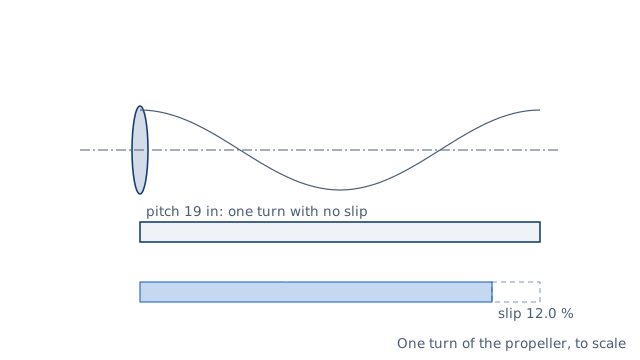
Drawn for the default inputs. It redraws as you change them.
Results are estimates. They do not replace the governing code, class or flag requirements, or a check by a competent person. Report a problem
Introduction
Propeller pitch is the distance a propeller would move forward in one turn if it screwed through the water like a bolt through a nut. Multiply the pitch by the propeller rpm and you have the theoretical speed. A 19 in propeller turning 2 750 rpm would advance 52 250 in per minute, which is 43.0 kn. The boat goes slower than that because the water gives way: the shortfall is the slip.
This calculator gives the boat speed from pitch, engine rpm, gear ratio and slip. It also works backwards: the pitch you need for a target speed, or the slip you are getting from a speed measured with GPS. It is for boat owners choosing a propeller for an outboard, stern drive or inboard. The propeller slip calculator does the same job for ships, with current and wake fraction.
pitch — the nominal pitch, the second number on the propeller (14 × 19 means 19 in of pitch)
gear ratio — engine turns per propeller turn, from the engine manual (2.0:1 halves the rpm)
slip — apparent slip, as a fraction or percentage
Assumptions and limitations
Slip here is apparent slip. It lumps together the real slip of the blades, the wake of the hull, any current and the error in your speed reading.
Measure speed with GPS on runs in both directions and average them, in calm water and with a typical load.
A bigger pitch only gives more speed if the engine can still reach its rated rpm range at wide-open throttle. Too much pitch overloads the engine and pulls the rpm down.
Cupped and progressive-pitch propellers act as if their pitch were larger than the stamped value, so they show less apparent slip.
Worked example
An outboard turns 5 500 rpm at wide-open throttle through a 2.0:1 gearcase. It has a 19 in pitch propeller, and the slip is 12 %. What speed should the boat make?
If the GPS shows 37 kn instead, the slip is 1 − 37 / 43.0 = 13.9 %. To reach 40 kn at the same rpm and 12 % slip, the propeller would need 20.1 in of pitch.
The worked example, drawn by the same code as the live drawing above.
FAQ
How do I calculate boat speed from propeller pitch?
Multiply the pitch in inches by the propeller rpm and divide by 1 215.2 for knots, or by 1 056 for mph. Then take off the slip.
What is propeller slip?
The difference between the theoretical speed, pitch × rpm, and the speed the boat actually makes, as a percentage of the theoretical speed.
How do I measure slip on my boat?
Choose the slip mode and enter the pitch, the rpm at wide-open throttle, the gear ratio and the average GPS speed of runs both ways.
Does more pitch mean more speed?
Only while the engine still reaches its rated rpm. More pitch loads the engine harder, so the rpm drops; if it falls below the rated range, the boat may get slower and the engine is overloaded.
Where do I find the gear ratio?
In the engine's manual or specification sheet. Outboards and stern drives list the lower-unit ratio; inboards list the gearbox reduction.
What does negative slip mean?
The boat went faster than pitch × rpm allows. Usually the gear ratio, pitch or rpm entered is wrong, or a following current pushed the boat.
Before every release the calculator must reproduce each case below. The note under each case says where the expected answer comes from: a standard, a textbook, a published table, or a hand calculation shown in full.
19 in pitch at 5 500 engine rpm through 2.0:1: 2 750 propeller rpm, 43.0 kn theoretical, 37.8 kn at 12 % slipGerr, The Propeller Handbook: V = pitch × rpm; US rule V[kn] = pitch[in] × rpm / 1 215.2; hand calculation
Ship check: 6 m pitch at 100 rpm direct drive is 36 000 m/h = 19.438 kn (the propeller-slip calculator's example)MAN, Basic Principles of Ship Propulsion (apparent slip); 1 nmi = 1 852 m
Slip from GPS: 37 kn against 43.0 kn theoretical is 13.9 % apparent slipSlip = 1 − V / (pitch × rpm); hand calculation
Pitch for 40 kn at 2 750 propeller rpm and 12 % slip is 20.1 in; feeding it back gives 40 knP = V / ((1 − s) n); consistency check
Negative slip warns; zero rpm and a gear ratio of 0.2 are rejectedBehaviour check: warnings and rejected inputs
Worked example of the article: the calculator reproduces 2 750 rpm, 43.0 kn, 37.8 kn to the digits printedThe worked example on this page, to the digits printed
Assumptions and sources
Assumptions and limits
Pitch is the nominal pitch stamped on the propeller (the second number of 14 × 19 is 19 in of pitch). Cupped and progressive-pitch propellers behave as if their pitch were somewhat larger.
The gear ratio is engine turns per propeller turn (2.0:1 means the propeller turns at half the engine rpm). Use the lower-unit or gearbox ratio from the engine manual.
Slip here is apparent slip: the shortfall of the measured speed against pitch × propeller rpm. It mixes propeller slip with wake, current and the error of the speed reading, so measure with GPS on runs both ways in calm water.
The required pitch keeps the engine at the chosen rpm only if the propeller can absorb the engine power there; a larger pitch loads the engine and pulls the rpm down. Aim for the top of the rated rpm range at wide-open throttle.
Sources
D. Gerr, The Propeller Handbook (International Marine, 1989): pitch, apparent slip and the theoretical speed pitch × rpm
MAN Energy Solutions, Basic Principles of Ship Propulsion (2018): apparent and real slip ratio
Cite this calculator
Papandreou, C. (2026). Propeller pitch and boat speed calculator. Engineering Bible. https://engineeringbible.com/maritime/prop-pitch-speed/
Embed this calculator on your site
Copy this HTML into your page. The calculator stays free to use and links back here.