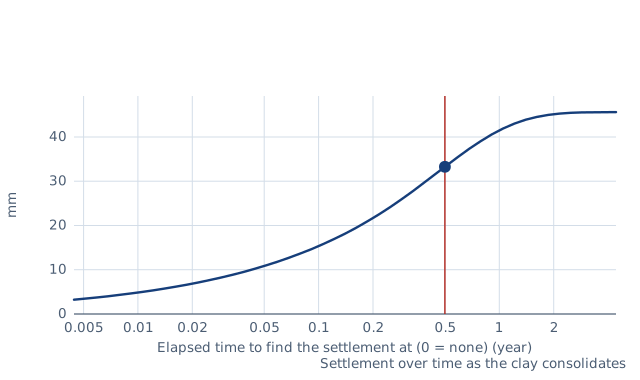
Drawn for the default inputs. It redraws as you change them.
Results are estimates. They do not replace the governing code, class or flag requirements, or a check by a competent person. Report a problem
Introduction
A saturated clay loaded by a fill or a building settles slowly as water is squeezed out of its pores. This is primary consolidation. Its size depends on how compressible the clay is and on how far the new stress goes past the highest stress the clay has carried before. A 3 m clay layer loaded from 80 to 140 kPa, with a preconsolidation pressure of 120 kPa, settles about 46 mm.
This calculator gives the primary consolidation settlement of a clay layer for normally and over-consolidated clays. It also gives the time to reach a chosen degree of consolidation, the time for 50 %, and the settlement after a given time, from Terzaghi's one-dimensional theory. It is for geotechnical engineers, students and designers of embankments and shallow foundations on clay.
Formulas
Settlement, with σ'1 = σ'0 + Δσ:
normally consolidated:            S = Cc H/(1 + e0) log(σ'1/σ'0)
over-consolidated, σ'1 ≤ σ'p:     S = Cr H/(1 + e0) log(σ'1/σ'0)
over-consolidated, σ'1 > σ'p:     S = Cr H/(1 + e0) log(σ'p/σ'0) + Cc H/(1 + e0) log(σ'1/σ'p)
Rate of consolidation (Terzaghi):
T_v = c_v t / H_dr²
U = 1 − Σ (2/M²) exp(−M² T_v),   M = π(2m + 1)/2,  m = 0, 1, 2 …
T_v ≈ (π/4) U²  for U ≤ 60 %;    T_v ≈ 1.781 − 0.933 log(100 − U%)  for U > 60 %
H — layer thickness; e0 — initial void ratio; Cc, Cr — compression and recompression indices
c_v — coefficient of consolidation; H_dr — drainage path, H/2 when both faces drain
Assumptions and limitations
The clay is saturated and laterally confined, and the stresses are taken at mid-layer. Divide thick layers into sublayers and add their settlements.
The parameters come from an oedometer test (ASTM D2435) on undisturbed samples. Sample disturbance lowers the apparent σ'p and raises the settlement.
Terzaghi's theory assumes a constant c_v and a load applied at once. Field consolidation is often faster than predicted, because of thin sand layers in the clay.
Immediate settlement and secondary compression are not included. Secondary compression can be large in organic and very soft clays.
Worked example
A 3 m clay layer lies between sand layers. At mid-layer σ'0 = 80 kPa, the oedometer gives σ'p = 120 kPa, e0 = 0.9, Cc = 0.30 and Cr = 0.05. A fill adds Δσ = 60 kPa. c_v is 2 m²/year.
OCR = 120 / 80 = 1.50. The final stress, 140 kPa, is above σ'p, so both branches apply.
Double drainage: H_dr = 1.5 m. For 90 % consolidation T_v = 0.848, so t = 0.848 × 1.5² / 2 = 0.954 year.
After six months T_v = 0.444, the layer is 72.9 % consolidated and has settled 33.3 mm.
The worked example, drawn by the same code as the live drawing above.
FAQ
What is consolidation settlement?
The slow settlement of a saturated clay as pore water drains out under a new load. It can take months to decades, unlike the immediate settlement of sand.
What is the difference between normally and over-consolidated clay?
A normally consolidated clay has never carried more than its present effective stress. An over-consolidated clay has, so it is much stiffer until the load passes its preconsolidation pressure.
How do I estimate the compression index?
From an oedometer test. Without one, Cc ≈ 0.009 (LL − 10) for normally consolidated clays of low sensitivity, with LL the liquid limit in percent.
What is a typical recompression index?
About one fifth to one tenth of Cc. It applies to reloading below the preconsolidation pressure.
What does double drainage mean?
Water can leave through both the top and the bottom of the layer, so the longest drainage path is half the thickness. Since time grows with the square of the path, double drainage is four times faster.
How can consolidation be speeded up?
Preloading with a surcharge and installing vertical wick drains, which shorten the drainage path to half the drain spacing.
Before every release the calculator must reproduce each case below. The note under each case says where the expected answer comes from: a standard, a textbook, a published table, or a hand calculation shown in full.
Time factors: U 10 % → 0.008, 20 % → 0.031, 30 % → 0.071, 40 % → 0.126, 50 % → 0.197, 60 % → 0.287, 70 % → 0.403, 80 % → 0.567, 90 % → 0.848Das & Sobhan, Principles of Geotechnical Engineering, ch. 11: table of T_v against U from Terzaghi's solution
Approximations: T_v = (π/4) U² below 60 % is exact to 1e-6 at U = 30 %; 1.781 − 0.933 log(100 − U%) is within 0.3 % at 90 %; the series inverts to itselfDas & Sobhan, ch. 11 (approximations of Terzaghi's solution quoted there)
Normally consolidated: 4 m, e0 1.1, Cc 0.36, 100 → 150 kPa: S = 0.36 × 4/2.1 × log 1.5 = 120.7 mmHand calculation: S = Cc H/(1 + e0) log(σ'1/σ'0) (Das & Sobhan, ch. 11)
Over-consolidated example: 3 m, e0 0.9, Cc 0.30, Cr 0.05, 80 → 140 kPa past σ'p 120 kPa: 13.90 + 31.71 = 45.6 mm; staying below σ'p uses Cr onlyHand calculation: S = Cr H/(1 + e0) log(σ'p/σ'0) + Cc H/(1 + e0) log(σ'1/σ'p) (Das & Sobhan, ch. 11)
Rate: c_v 2 m²/year, H_dr 1.5 m, t90 = 0.848 × 2.25/2 = 0.954 years; single drainage takes 4 times as long; 2 m²/year = 6.34 × 10⁻⁴ cm²/sT_v = c_v t / H_dr² (Terzaghi); unit conversion with the 365.25-day year
σ'p below σ'0 and Cr above Cc are refused; a very thick layer warnsBehaviour check: warnings and rejected inputs
Worked example of the article: the calculator reproduces 45.6 mm, 0.848, 0.954 year, 1.50 to the digits printedThe worked example on this page, to the digits printed
Assumptions and sources
Assumptions and limits
One-dimensional consolidation: the clay is laterally confined, saturated and loaded over a wide area, and the stresses are those at the middle of the layer. Thick layers should be split into sublayers and the settlements added.
Cc, Cr (also called Cs), e0 and the preconsolidation pressure come from an oedometer test (ASTM D2435) on undisturbed samples; the void ratio changes linearly with the logarithm of effective stress on each branch.
The rate follows Terzaghi's theory with a constant c_v, an instantly applied load and a uniform initial excess pore pressure. Double drainage halves the drainage path.
Immediate (elastic) settlement and secondary compression (creep) are not included; secondary compression can be significant in organic and soft clays.
Sources
Das, B.M. and Sobhan, K., Principles of Geotechnical Engineering, 9th ed., Cengage, ch. 11 Compressibility of Soil (settlement equations for normally and overconsolidated clay; Terzaghi time factor table and approximations)
Terzaghi, K. (1925), Erdbaumechanik auf bodenphysikalischer Grundlage, Deuticke, Vienna (one-dimensional consolidation theory)
ASTM D2435/D2435M, Standard Test Methods for One-Dimensional Consolidation Properties of Soils Using Incremental Loading