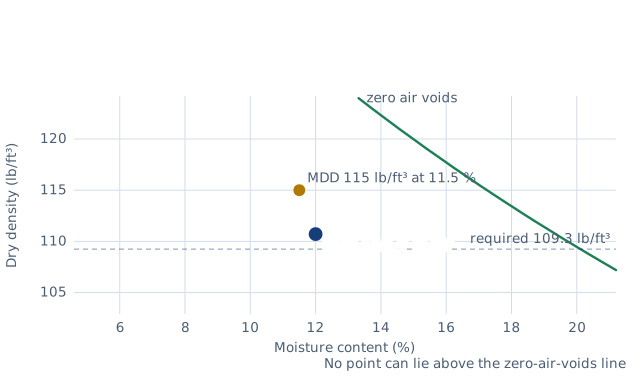
Field dry density from wet density and moisture, relative compaction against the Proctor maximum, saturation, air voids and the zero-air-voids density.
Drawn for the default inputs. It redraws as you change them.
Results are estimates. They do not replace the governing code, class or flag requirements, or a check by a competent person. Report a problem
Introduction
Fill under roads, slabs and foundations is specified by relative compaction: the field dry density as a percentage of the laboratory Proctor maximum. A field test gives the wet density and the moisture content. Dividing the wet density by one plus the moisture content gives the dry density. Soil at 124.0 lb/ft³ wet and 12 % moisture has a dry density of 110.7 lb/ft³, which is 96.3 % of a 115.0 lb/ft³ Proctor maximum.
This calculator gives the field dry density and the relative compaction, and says whether it meets the specification. It adds the void ratio, porosity, degree of saturation, air voids and the zero-air-voids density, which show whether the test result is physically possible. It is for earthwork inspectors, geotechnical technicians, contractors and students.
Formulas
Dry density and relative compaction:
ρ_d = ρ / (1 + w)
RC = ρ_d / ρ_d,max × 100 %
Weight–volume relations:
e = G_s ρ_w / ρ_d − 1,    n = e / (1 + e)
S = w G_s / e
V_a = 1 − (ρ_d / ρ_w)(1/G_s + w)
Zero-air-voids density, the upper limit at moisture w:
ρ_zav = G_s ρ_w / (1 + w G_s)
ρ — wet (bulk) density; w — moisture content as a decimal
ρ_d,max — maximum dry density from the Proctor test
G_s — specific gravity of the soil solids; ρ_w = 1 000 kg/m³ = 62.43 lb/ft³
Assumptions and limitations
Field tests are the sand cone (ASTM D1556) or the nuclear gauge (ASTM D6938). Check gauge moisture against oven-dried samples.
The Proctor test must be on the same soil and at the specified effort. Standard Proctor (ASTM D698) uses 12 400 ft·lbf/ft³ and modified Proctor (ASTM D1557) 56 000 ft·lbf/ft³.
Gravel removed from the laboratory sample makes the field density look too high. Apply the oversize correction of ASTM D4718.
G_s affects only the saturation, void ratio and zero-air-voids values, not the relative compaction. Use a measured value; 2.65 to 2.75 covers most soils.
Worked example
A nuclear gauge on a compacted fill reads a wet density of 124.0 lb/ft³ and a moisture content of 12.0 %. The standard Proctor test gave 115.0 lb/ft³ at 11.5 % moisture. G_s is 2.70 and the specification asks for 95 %.
Dry density: 124.0 / 1.12 = 110.714, or 110.7 lb/ft³.
Relative compaction: 110.7 / 115.0 = 96.3 %. The fill passes; the lowest passing dry density is 0.95 × 115.0 = 109.3 lb/ft³.
Saturation: 0.12 × 2.70 / 0.5224 = 62.0 %. The air voids are 13.0 % of the volume.
Zero-air-voids density at 12 %: 2.70 × 62.43 / (1 + 0.12 × 2.70) = 127.3 lb/ft³. The field point lies well below it, so the test is plausible.
The moisture is 0.5 % above optimum, which is within the usual range for good compaction.
The worked example, drawn by the same code as the live drawing above.
FAQ
What is relative compaction?
The field dry density divided by the maximum dry density from the laboratory Proctor test. Specifications typically ask for 90 to 100 %, depending on the use of the fill and the test effort.
What is the difference between standard and modified Proctor?
The compaction energy. Modified Proctor uses a heavier hammer, a longer drop and five layers, about 4.5 times the energy, so it gives a higher maximum and a lower optimum moisture.
How do I convert wet density to dry density?
Divide by one plus the moisture content as a decimal. At 15 % moisture, 2 000 kg/m³ wet is 2 000 / 1.15 = 1 739 kg/m³ dry.
What is the zero-air-voids curve?
The dry density a soil would have at a given moisture if all its voids were full of water. No compacted soil can lie above it.
Why can relative compaction exceed 100 %?
Field rollers can put in more energy than the laboratory test, or the field soil can be coarser than the tested sample. Values above about 105 % call for a check of the reference test.
Why does moisture content matter?
Below optimum the grains resist sliding into a dense packing. Above it, water fills the voids and the soil cannot be densified, so specifications often limit moisture to a band around optimum.
Before every release the calculator must reproduce each case below. The note under each case says where the expected answer comes from: a standard, a textbook, a published table, or a hand calculation shown in full.
Wet 124.0 lb/ft³ at 12 %: dry 124/1.12 = 110.71 lb/ft³, 96.3 % of 115.0; e = 2.70 × 62.43/110.71 − 1 = 0.522; S = 0.12 × 2.70/0.522 = 62.0 %Hand calculation: ρ_d = ρ/(1 + w), e = G_s ρ_w/ρ_d − 1, S e = w G_s (Das & Sobhan, Principles of Geotechnical Engineering, ch. 3)
Zero-air-voids density: G_s 2.68 at w 20 % is 2 680/1.536 = 1 744.8 kg/m³ (17.12 kN/m³); G_s 2.72 at 10 % is 133.5 lb/ft³Das & Sobhan, ch. 6: γ_zav = G_s γ_w / (1 + w G_s); hand calculation
A soil compacted to the zero-air-voids density is 100 % saturated with no air voids; air voids equal n (1 − S) in generalDefinition of the zero-air-voids curve; V_a = n (1 − S)
Dry-density input gives the same results as the wet density ρ_d (1 + w); saturation at the Proctor optimum 115.0 lb/ft³ and 11.5 % is 66.7 %Consistency; hand calculation S = w G_s / (G_s ρ_w/ρ_d,max − 1)
Low compaction fails; a dry density above G_s ρ_w is refused; a point above the zero-air-voids curve warnsBehaviour check: warnings and rejected inputs
Worked example of the article: the calculator reproduces 110.7 lb/ft³, 96.3 %, 0.522, 62.0 %, 127.3 lb/ft³ to the digits printedThe worked example on this page, to the digits printed
Assumptions and sources
Assumptions and limits
The wet density and moisture content come from a field test such as the sand cone (ASTM D1556) or the nuclear gauge (ASTM D6938), and the oven moisture content is preferred to a gauge reading.
The maximum dry density and optimum moisture come from a laboratory compaction test on the same soil: standard Proctor (ASTM D698, 600 kN·m/m³) or modified Proctor (ASTM D1557, 2 700 kN·m/m³).
The density of water is 1 000 kg/m³ (62.43 lb/ft³). The specific gravity of solids should be measured (ASTM D854); 2.65 to 2.75 is typical of most soils.
Oversize particles removed from the laboratory sample need the rock correction of ASTM D4718 before the relative compaction is meaningful.
Sources
ASTM D698-12(2021), Standard Test Methods for Laboratory Compaction Characteristics of Soil Using Standard Effort (12 400 ft-lbf/ft³ (600 kN-m/m³)), and ASTM D1557-12(2021) for modified effort (56 000 ft-lbf/ft³ (2 700 kN-m/m³))
Das, B.M. and Sobhan, K., Principles of Geotechnical Engineering, 9th ed., Cengage, ch. 3 Weight–Volume Relationships and ch. 6 Soil Compaction (zero-air-void unit weight)
ASTM D1556/D1556M Density and Unit Weight of Soil in Place by Sand-Cone Method; ASTM D6938 In-Place Density and Water Content by Nuclear Methods