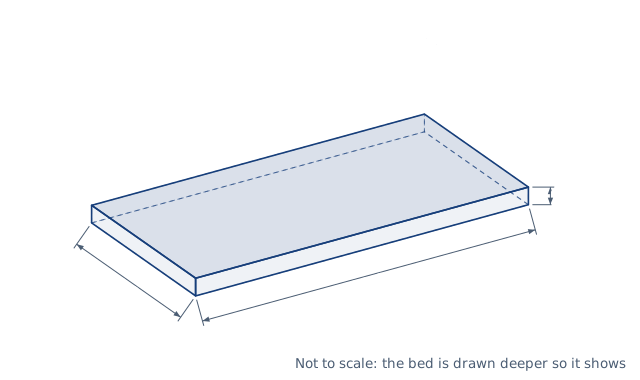
Drawn for the default inputs. It redraws as you change them; drag it, or use the arrow keys, to turn it.
Results are estimates. They do not replace the governing code, class or flag requirements, or a check by a competent person. Report a problem
Introduction
How much gravel do you need? Multiply the length, width and depth to get the volume, convert it to cubic yards, then multiply by the weight of a cubic yard to get tons. A path 20 ft long and 10 ft wide, covered 4 in deep, takes 2.47 cubic yards of crushed stone. With an allowance for compaction that is about 3.7 short tons.
This calculator does the sums for gravel, crushed stone, sand, sand and gravel, and topsoil. It gives the volume in place and the volume to order, the weight in short tons and metric tonnes, the number of truck loads and the cost. It is for homeowners, landscapers and contractors ordering bulk material by the yard or by the ton.
Formulas
Volume in place and volume to order:
V = L × W × d
V_order = V × (1 + c)
Weight, truck loads and cost:
m = V_order × ρ
loads = larger of V_order / truck volume and m / truck payload, rounded up
cost = tons × price per ton
L, W — length and width of the area; d — compacted depth, with inches divided by 12 to get feet
c — compaction and settlement allowance, as a fraction
ρ — loose bulk density of the delivered material
1 yd³ = 27 ft³ = 0.7646 m³; 1 short ton = 2 000 lb = 907.2 kg
Loose bulk densities from the Caterpillar Performance Handbook:
Material
kg/m³
lb/yd³
short tons per yd³
Crushed stone
1 600
2 700
1.35
Gravel, dry, ¼ to 2 in
1 690
2 850
1.43
Sand and gravel, dry
1 720
2 900
1.45
Sand, dry
1 420
2 400
1.20
Topsoil
950
1 600
0.80
Assumptions and limitations
The area is a rectangle, or an area you enter, covered to an even depth. Split an irregular area into rectangles and add the results.
The depth is the finished depth after compaction. The allowance adds the volume lost when loose stone is spread and rolled. 10 to 15 % is usual for a compacted base.
The weights are typical loose weights. Wet material is heavier, and different rock types differ. Ask your quarry for its weight per yard when you buy by the ton.
Truck capacity and payload vary with the truck and with state weight limits. Enter your hauler's figures.
Worked example
A garden path is 20 ft long, 10 ft wide and 4 in deep, in crushed stone. How much should you order with a 10 % compaction allowance, and what does it cost at $40 per ton?
Depth in feet: 4 / 12 = 0.333 ft.
Volume: 20 × 10 × 0.333 = 66.7 ft³, which is 66.7 / 27 = 2.47 yd³.
With 10 % allowance: 2.47 × 1.10 = 2.72 yd³, or 73.3 ft³.
Weight: 2.72 yd³ × 2 697 lb/yd³ = 7 325 lb, which is 3.66 short ton.
Cost: 3.66 × $40 = $146.50.
The load fits in one truck. In metric terms it is 2.08 m³ and 3.32 tonnes.
The worked example, drawn by the same code as the live drawing above.
FAQ
How many tons are in a cubic yard of gravel?
About 1.35 short tons of crushed stone and 1.43 of dry gravel, loose. Sand weighs about 1.2 tons per yard and topsoil about 0.8.
How many square feet does a cubic yard of gravel cover?
A cubic yard is 27 ft³. It covers 162 ft² at 2 in deep, 108 ft² at 3 in and 81 ft² at 4 in.
How many cubic yards are in a ton of crushed stone?
About 0.74 yd³, since a loose cubic yard weighs about 2 700 lb.
Why add a compaction allowance?
Loose stone settles when it is spread and rolled. Ordering the compacted volume alone leaves the area short, so 10 to 15 % is usually added for a base course.
Why is the weight in place higher than the loose weight?
Compaction squeezes out voids. Caterpillar lists crushed stone at 1 600 kg/m³ loose but 2 670 kg/m³ in the solid bank.
How many bags of gravel make a cubic yard?
54 bags of 0.5 ft³, because a cubic yard is 27 ft³. Bulk delivery is usually cheaper above a cubic yard or two.
Before every release the calculator must reproduce each case below. The note under each case says where the expected answer comes from: a standard, a textbook, a published table, or a hand calculation shown in full.
20 × 10 ft, 4 in of crushed stone: 2.47 yd³, 2.72 yd³ with 10 % compaction, 3.66 short ton, $146.50 at $40 per tonHand calculation: 20 × 10 × 4/12 = 66.67 ft³ / 27 = 2.469 yd³; × 1.1 = 2.716 yd³ × 1 600 kg/m³ = 3 322.5 kg = 3.662 short ton
Caterpillar loose weights per cubic yard: crushed stone 2 700 lb, gravel 2 850, sand 2 400, sand and gravel 2 900, topsoil 1 600Caterpillar Performance Handbook, weights of materials (loose kg/m³ and lb/yd³ columns, rounded)
Metric: 5 × 4 m of dry sand 100 mm deep, no allowance: 2.0 m³, 2 840 kg, 85.20 at 30 per tonneHand calculation: 5 × 4 × 0.1 = 2 m³ × 1 420 kg/m³ = 2 840 kg
Truck loads take the tighter limit: 30 yd³ of crushed stone (40.5 short ton) is 2 loads of 20 yd³ by volume but 3 loads of 15 ton by weightHand calculation: 30 × 2 697 lb = 80 910 lb = 40.5 short ton; 40.5 / 15 = 2.7, rounded up to 3
Custom density is used; a 1 in layer warns; zero depth, an unknown material and a density of 5 000 kg/m³ are rejectedBehaviour check: warnings and rejected inputs
Worked example of the article: the calculator reproduces 2.47 yd³, 2.72 yd³, 3.66 short ton, 146.50 to the digits printedThe worked example on this page, to the digits printed
Assumptions and sources
Assumptions and limits
The area is a rectangle, or an area you enter, covered to a uniform depth; split irregular areas into rectangles and add them.
Tonnage uses the loose bulk density of the delivered material from the Caterpillar Performance Handbook; the real figure varies with moisture, grading and rock type, so use the supplier's weight per yard when you have it.
The compaction allowance covers the volume lost when loose material is spread and compacted; 10 to 15 % is usual for base courses and less for loose decorative stone.
Truck loads are the larger of the volume and weight limits you enter; legal payloads vary by truck and by state.
Sources
Caterpillar Performance Handbook, Tables section: approximate weights of materials, loose and bank (crushed stone 1 600 kg/m³, gravel dry ¼–2 in 1 690, sand and gravel dry 1 720, sand dry 1 420, topsoil 950)
NIST Handbook 44, Appendix C, and NIST SP 811, Appendix B (1 yd³ = 27 ft³ = 0.764555 m³; 1 short ton = 2 000 lb)
Cite this calculator
Papandreou, C. (2026). Gravel calculator: cubic yards and tons. Engineering Bible. https://engineeringbible.com/civil/gravel/
Embed this calculator on your site
Copy this HTML into your page. The calculator stays free to use and links back here.