Introduction
How much water comes out of a nozzle? The pressure at the nozzle turns into jet velocity, and the flow is that velocity times the opening area times a discharge coefficient. Fire crews use the same physics in the form Q = 29.84 c d² √p, in gpm, inches and psi. A 1-1/8 inch smooth-bore tip at 50 psi flows about 266 gpm.
This calculator gives the flow from the size and pressure, the pressure for a flow, or the orifice size for a flow and pressure. It works with an orifice diameter and discharge coefficient, or with a K-factor for sprinklers and spray nozzles. It also gives the jet velocity, the equivalent K-factor and the reaction force the crew or the pipe support must hold. It is for fire protection engineers, fire crews, hydrant testers and anyone sizing spray nozzles.
Formulas
Orifice equation, any consistent units:
Q = Cd × A × √(2 Δp / ρ), A = π d² / 4Fire-service form (NFPA 291), Q in gpm, d in inches, p in psi:
Q = 29.84 × c × d² × √pK-factor form (NFPA 13), US gpm/psi½ or metric L/min/bar½:
Q = K × √p, K_metric = 14.42 × K_USJet velocity and nozzle reaction:
v = √(2 Δp / ρ)
F = ρ × Q × v          (= 1.57 d² p in lbf for a smooth bore, IFSTA)
F_fog = 0.0505 × Q × √p (IFSTA fog nozzle, lbf, gpm, psi)- Q — flow; Δp, p — gauge pressure at the nozzle or pitot pressure in the jet
- d — orifice or tip diameter; A — its area
- Cd, c — discharge coefficient; ρ — liquid density, 999 kg/m³ for fresh water
- K — K-factor, which holds the area and the discharge coefficient together
Assumptions and limitations
- The jet discharges to the atmosphere. The velocity of the water approaching the nozzle is neglected, which is fine when the nozzle is much smaller than the hose or pipe.
- The discharge coefficient comes from the nozzle shape. A smooth-bore fire nozzle is 0.97 to 1.0. NFPA 291 gives 0.90 for a smooth rounded hydrant outlet, 0.80 for a square sharp one and 0.70 for one projecting into the barrel. A sharp-edged hole is about 0.6.
- The reaction uses the ideal jet velocity. It equals the IFSTA smooth-bore formula 1.57 d² p when Cd is 1. The IFSTA fog-nozzle formula is shown too and gives about 4 % less.
- Sprinkler K-factors come from the listing of the sprinkler. NFPA 13 requires at least 7 psi (0.5 bar) at any operating sprinkler, and the calculator warns below that.
Worked example
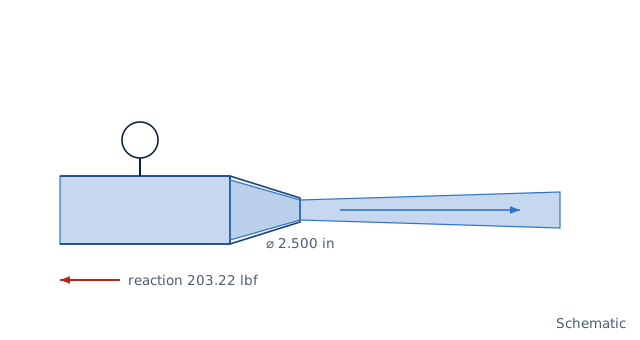
A hydrant flow test uses a 2½ inch outlet with a smooth rounded lip, c = 0.90. The pitot gauge in the stream reads 23 psi. What is the flow?
- Fire-service formula: 29.84 × 0.90 × 2.5² × √23 = 805 US gpm.
- Area: π / 4 × 0.0635² = 0.003167 m². Pressure: 23 psi = 158.6 kPa.
- Jet velocity: √(2 × 158 579 / 999) = 17.82 m/s, or 58.5 ft/s.
- Orifice equation: 0.90 × 0.003167 × 17.82 = 0.0508 m³/s, the same 805 US gpm.
- Equivalent K-factor: 805 / √23 = 167.8 gpm/psi½.
- Reaction: 999 × 0.0508 × 17.82 = 904 N, or 203 lbf.
The City of Temecula's fire flow examples print 804 gpm for the same test; the difference is rounding.
FAQ
How do I calculate the flow from a nozzle?
Multiply the discharge coefficient, the opening area and the jet velocity √(2Δp/ρ). In US fire-service units the shortcut is 29.84 × c × d² × √p.
What is a K-factor?
The flow at a pressure of 1 psi (or 1 bar), so that Q = K√p. A standard K 5.6 sprinkler flows 5.6 × √7 = 14.8 gpm at the 7 psi minimum.
How do I convert a US K-factor to metric?
Multiply by 14.42. K 5.6 becomes about K80, and K 8.0 becomes about K115.
What discharge coefficient should I use for a hydrant?
NFPA 291 uses 0.90 for a smooth, well-rounded outlet, 0.80 for a square sharp outlet and 0.70 for an outlet that projects into the barrel. Feel the inside lip of the outlet to decide.
What is nozzle reaction?
The push-back force of the jet, equal to its momentum flow. For a smooth bore it is 1.57 × d² × p in pounds; a 7/8 inch tip at 50 psi pushes back about 60 lb.
Why does doubling the pressure not double the flow?
Flow grows with the square root of pressure. Doubling the pressure raises the flow by only 41 %, while doubling the orifice diameter quadruples it.
Related calculators
- Orifice and venturi flow (ISO 5167) — metering orifices in a pipe.
- Pump power — the power to supply the nozzles.
- Total dynamic head — friction and static head up to the nozzle.
- Minor losses — losses in the fittings and valves on the way.