Mixed air temperature calculator (outdoor and return air)
Mixed air dry bulb, humidity ratio, enthalpy, RH and wet bulb of outdoor and return air streams by psychrometric mass balance, and the outdoor-air fraction.
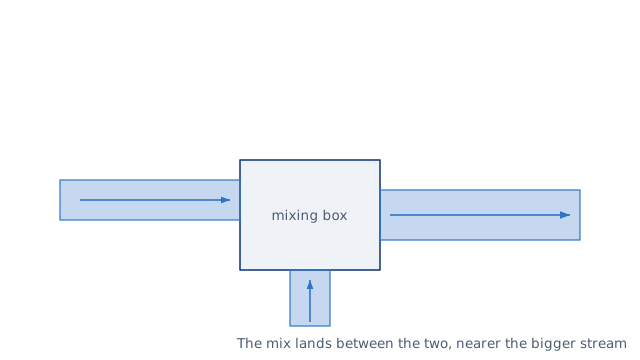
Drawn for the default inputs. It redraws as you change them.
Results are estimates. They do not replace the governing code, class or flag requirements, or a check by a competent person. Report a problem
Introduction
Most air handlers mix some outdoor air with air returned from the building before it reaches the coil. The mixed air temperature is close to the flow-weighted average of the two streams. Mixing 2 000 cfm of outdoor air at 95 °F with 8 000 cfm of return air at 75 °F gives 78.9 °F.
This calculator does the full psychrometric mass balance of dry air, water vapour and energy. It gives the mixed dry bulb, humidity ratio, enthalpy, relative humidity, wet bulb and dew point, and the outdoor-air fraction by mass and by volume. A second mode finds the outdoor-air fraction from measured outdoor, return and mixed temperatures. It is for HVAC designers, test and balance technicians and students.
Formulas
Dry air mass flow of each stream, then the mass balances:
Mixed dry bulb from enthalpy and humidity ratio (SI, ASHRAE eq. 30):
h = 1.006 t + W (2 501 + 1.86 t) → t_mix = (h_mix − 2 501 W_mix) / (1.006 + 1.86 W_mix)
Outdoor-air fraction from measured temperatures:
x_OA = (t_RA − t_MA) / (t_RA − t_OA)
Q — airflow at the stream's own condition; v — specific volume per kg of dry air
W — humidity ratio, kg of water per kg of dry air; h — enthalpy, kJ/kg of dry air
t_OA, t_RA, t_MA — outdoor, return and mixed air dry bulb temperatures
Assumptions and limitations
Mixing is adiabatic at constant pressure. On a psychrometric chart the mixed state lies on the straight line between the two stream states.
Each airflow is the actual volume at its own temperature. The calculator converts it to dry air mass, so a cold dense outdoor stream counts for more than its volume suggests.
Properties follow ASHRAE Fundamentals Chapter 1 at the standard pressure for the altitude entered.
The temperature method for the outdoor-air fraction needs a clear difference between outdoor and return air. With 10 °F between them, a 1 °F sensor error shifts the fraction by 10 points.
If the mixed state falls beyond saturation, the extra moisture forms fog and the calculator warns.
Worked example
ASHRAE Fundamentals Chapter 1 mixes 2 m³/s of outdoor air at 4 °C dry bulb and 2 °C wet bulb with 6.25 m³/s of return air at 25 °C and 50 % relative humidity, at sea level.
Outdoor air: W = 3.55 g/kg, v = 0.790 m³/kg, h = 12.9 kJ/kg.
Return air: W = 9.88 g/kg, v = 0.858 m³/kg, h = 50.3 kJ/kg.
Dry air flows: 2 / 0.790 = 2.533 kg/s and 6.25 / 0.858 = 7.284 kg/s. Outdoor air is 25.8 % by mass.
ASHRAE reads 19.5 °C and 14.6 °C from the chart. A plain volume average would give 19.9 °C.
The worked example, drawn by the same code as the live drawing above.
FAQ
How do I calculate mixed air temperature?
For a quick answer, take the flow-weighted average: (Q_OA × t_OA + Q_RA × t_RA) / (Q_OA + Q_RA). For an exact answer, weight by dry air mass and work through enthalpy, as this calculator does.
How do I find the outdoor-air percentage from temperatures?
Divide (return − mixed) by (return − outdoor). With 75 °F return, 95 °F outdoor and 79 °F mixed, the outdoor air is 4 / 20 = 20 %.
Why does the calculator use mass instead of volume?
Cold air is denser than warm air, so a cubic foot of it carries more air. In the ASHRAE example the volume average is 0.3 K too high.
Can mixing two airstreams make fog?
Yes. Very cold outdoor air mixed with warm, humid return air can land beyond the saturation curve, and the excess water condenses. Preheating the outdoor air avoids it.
What is the mixed air enthalpy used for?
It sets the cooling coil load: the dry air mass flow times the drop in enthalpy across the coil. The latent and sensible heat calculator splits that load.
Does altitude change the result?
Lower pressure raises the humidity ratio for the same relative humidity and makes the air less dense. Enter the altitude so the moisture content and mass flows are right.
Before every release the calculator must reproduce each case below. The note under each case says where the expected answer comes from: a standard, a textbook, a published table, or a hand calculation shown in full.
ASHRAE example: 2 m³/s at 4 °C db / 2 °C wb mixed with 6.25 m³/s at 25 °C, 50 % gives 19.5 °C db and 14.6 °C wbASHRAE Handbook — Fundamentals (2017), Ch. 1, adiabatic mixing example (v1 = 0.789, v2 = 0.858 m³/kg; ṁ1 = 2.535, ṁ2 = 7.284 kg/s)
Mass and energy balance: W and h of the mix are the dry-air-mass weighted means of the two streamsASHRAE Fundamentals Ch. 1, eqs. 46–48 (hand calculation from the stream states)
US case: 2 000 cfm at 95/75 °F with 8 000 cfm at 75 °F, 50 % mixes to 78.9 °F (volume average 79.0 °F), 20 % outdoor air by volumePsychrometric mass balance; volume-weighted check (2 000 × 95 + 8 000 × 75) / 10 000 = 79 °F
Outdoor-air fraction from temperatures: return 75 °F, outdoor 95 °F, mixed 79 °F gives 20 % and 2 000 of 10 000 cfmEnergy balance x = (t_RA − t_MA)/(t_RA − t_OA) (hand calculation)
Wet bulb and IP enthalpy: W from 25 °C db / 18 °C wb gives back 18 °C wb; 75 °F, 50 % is about 28.1 Btu/lb on the IP chartASHRAE Fundamentals Ch. 1 eq. 33 and IP eq. h = 0.240 t + W (1061 + 0.444 t); ASHRAE IP psychrometric chart No. 1
Cold saturated air mixed with warm humid air fogs (warning); wet bulb above dry bulb and no airflow are rejectedBehaviour check: warnings and rejected inputs
Worked example of the article: the calculator reproduces 19.6 °C, 14.6 °C, 8.25 g/kg, 40.7 kJ/kg, 25.8 % to the digits printedThe worked example on this page, to the digits printed
Assumptions and sources
Assumptions and limits
Mixing is adiabatic and at constant pressure: dry air, water and energy are conserved, and the mixed state lies on the straight line between the two states on a psychrometric chart (ASHRAE Fundamentals Ch. 1).
Each airflow is the actual volume at its own temperature and humidity; it is turned into a mass of dry air with the moist-air specific volume. The quick volume-weighted average is shown for comparison and is usually within a few tenths of a degree.
Moist-air properties follow ASHRAE Fundamentals Ch. 1 (Hyland–Wexler saturation pressure, ideal-gas mixture); pressure is the standard atmosphere at the altitude entered.
The outdoor-air fraction from measured temperatures assumes well-mixed air at the sensor and becomes unreliable when the outdoor and return temperatures are close: with 10 °F (5.6 K) between them, a 1 °F sensor error shifts the fraction by 10 points.
If the mixed state is beyond saturation, the excess moisture appears as fog; the dry bulb is then slightly higher than calculated.
Sources
ASHRAE Handbook — Fundamentals (2017), Chapter 1 Psychrometrics: eqs. 30, 33, 35 and adiabatic mixing of two moist airstreams (eqs. 46–48) with its worked example
Y. A. Çengel & M. A. Boles, Thermodynamics: An Engineering Approach, Ch. 14 Gas–vapor mixtures and air-conditioning (adiabatic mixing of airstreams)
Cite this calculator
Papandreou, C. (2026). Mixed air temperature calculator (outdoor and return air). Engineering Bible. https://engineeringbible.com/hvac/mixed-air-temperature/
Embed this calculator on your site
Copy this HTML into your page. The calculator stays free to use and links back here.