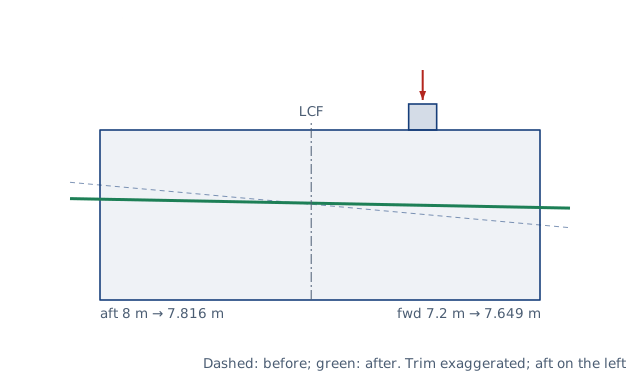
Drawn for the default inputs. It redraws as you change them.
Results are estimates. They do not replace the governing code, class or flag requirements, or a check by a competent person. Report a problem
Introduction
When a weight is moved along a ship, the ship trims about its centre of flotation. The change of trim in centimetres is the weight times the distance moved, divided by the moment to change trim one centimetre (MCTC). Shifting 120 t forward by 45 m on a ship with an MCTC of 240 t·m/cm trims it 22.5 cm by the head. A weight loaded or discharged also sinks or lifts the ship bodily by the weight divided by the tonnes per centimetre (TPC).
This calculator gives the bodily sinkage, the change of trim, the change at each end and the new forward and aft drafts after loading, discharging or shifting a weight. It also gives the positions where a weight can be loaded without changing the aft or forward draft. It is for deck officers and cadets planning cargo, ballast and bunker operations, and for students of ship stability.
Formulas
Bodily sinkage and change of trim:
sinkage = w / TPC                         cm
change of trim = w × d / MCTC             cm
Share of the trim at each end (LCF measured from the aft perpendicular):
change aft = change of trim × LCF / L
change forward = change of trim × (L − LCF) / L
Loading position for an unchanged aft draft:
d = MCTC × L / (TPC × LCF) forward of the LCF
w — weight in tonnes; d — its lever about the LCF in metres (for a shift, the distance moved)
TPC — tonnes per centimetre immersion; MCTC — moment to change trim 1 cm, t·m/cm
L — length between perpendiculars; trim is positive by the stern
Assumptions and limitations
The weight is small compared with the displacement, so TPC, MCTC and the LCF read at the initial draught stay valid. For large weights read them at the mean of the initial and final draughts.
Positions are measured from the aft perpendicular, positive forward. If your hydrostatic tables give the LCF from midships, add half the length to the value forward of midships.
Drafts are at the perpendiculars. Readings at the draught marks need correcting for the marks' positions.
A weight off the centreline also lists the ship, and a vertical shift changes GM. Use the initial stability calculator for those effects.
Worked example
A ship 150 m between perpendiculars floats at 7.20 m forward and 8.00 m aft. The LCF is 72 m from the aft perpendicular, TPC is 25 t/cm and MCTC is 180 t·m/cm. 300 t of cargo are loaded with their centre 110 m from the aft perpendicular.
Bodily sinkage: 300 / 25 = 12.0 cm.
Lever about the LCF: 110 − 72 = 38 m forward, so the trimming moment is 300 × 38 = 11 400 t·m by the head.
Change of trim: 11 400 / 180 = 63.3 cm by the head, written −63.3 cm.
Change aft: −63.3 × 72 / 150 = −30.4 cm. Change forward: +63.3 × 78 / 150 = +32.9 cm.
New draft aft: 8.00 + 0.120 − 0.304 = 7.816 m. New draft forward: 7.20 + 0.120 + 0.329 = 7.649 m.
To keep the aft draft unchanged, the cargo would go 180 × 150 / (25 × 72) = 15 m forward of the LCF, at 87.00 m from the aft perpendicular.
The worked example, drawn by the same code as the live drawing above.
FAQ
How do I calculate the change of trim?
Multiply the weight by its distance from the centre of flotation, or by the distance it is shifted, and divide by MCTC. The answer is in centimetres.
What is MCTC?
The moment to change trim one centimetre: the trimming moment in tonne-metres that changes the trim by 1 cm. It comes from the ship's hydrostatic tables at the current draught.
Why is the trim shared unequally between the ends?
The ship trims about the centre of flotation, which is rarely amidships. The end farther from the LCF moves more.
What is bodily sinkage?
The parallel rise or fall when weight is loaded or discharged at the LCF: the weight divided by TPC, in centimetres.
Where should I load a weight to keep the stern draft the same?
At MCTC × L / (TPC × LCF) forward of the centre of flotation. There the trim by the head exactly cancels the sinkage aft.
Can I use this for a large cargo operation?
For a few percent of the displacement it is accurate. For larger loadings use the loading condition calculator with the full hydrostatic table.
Before every release the calculator must reproduce each case below. The note under each case says where the expected answer comes from: a standard, a textbook, a published table, or a hand calculation shown in full.
Shift 120 t forward 45 m, MCTC 240, L 126 m, LCF 60 m from AP: trim 22.5 cm by the head, aft −10.7 cm, forward +11.8 cmDerrett & Barrass, Ship Stability for Masters and Mates, ch. 15 (change of trim = w d / MCTC, shared in the ratio of the LCF position); hand calculation
Load 300 t at 110 m from AP (LCF 72 m, TPC 25, MCTC 180, L 150): sinkage 12 cm, trim 63.3 cm by the head, A 7.816 m, F 7.649 mDerrett & Barrass ch. 9 and 15 (bodily sinkage then trim about the LCF); hand calculation
Loading at MCTC L / (TPC LCF) = 15 m forward of the LCF (87 m from AP) leaves the aft draft unchangedDerrett & Barrass ch. 15 (loading to keep the aft draft constant); consistency check
Loading then discharging the same weight at the same place restores the drafts; loading at the LCF only sinks the shipConsistency checks
LCF outside the length, zero MCTC and an unknown operation are rejectedBehaviour check: warnings and rejected inputs
Worked example of the article: the calculator reproduces 12.0 cm, −63.3 cm, 7.816 m, 7.649 m, 87.00 m to the digits printedThe worked example on this page, to the digits printed
Assumptions and sources
Assumptions and limits
The weight is small compared with the displacement (up to about 10 %), so TPC, MCTC and the LCF read at the initial mean draught stay valid. For larger weights take them at the mean of the initial and final draughts, or use a full loading calculation.
Positions are measured from the aft perpendicular, positive forward, and trim is positive by the stern, as in the hydrostatics calculator. LCF given from midships must be converted: LCF from AP = L/2 + LCF forward of midships.
A loaded weight first sinks the ship bodily by w / TPC at the LCF, then trims it about the LCF by w × lever / MCTC. A shifted weight only trims the ship.
Drafts are at the perpendiculars. Draught marks away from the perpendiculars need the usual correction for their position, as in a draft survey.
Only the longitudinal effect is calculated; a weight off the centreline also lists the ship, and a weight moved vertically changes GM (see the initial stability calculator).
Sources
Derrett, D.R. and Barrass, C.B., Ship Stability for Masters and Mates, 7th ed. (Butterworth-Heinemann, 2012), ch. 9 (TPC), ch. 15 (trim: change of trim and the effect of loading, discharging and shifting weights)
Lewis, E.V. (ed.), Principles of Naval Architecture, 2nd rev. (SNAME, 1988), Vol. I: hydrostatics, moment to change trim and the centre of flotation
Cite this calculator
Papandreou, C. (2026). Change of trim and new drafts calculator. Engineering Bible. https://engineeringbible.com/maritime/trim-change/
Embed this calculator on your site
Copy this HTML into your page. The calculator stays free to use and links back here.