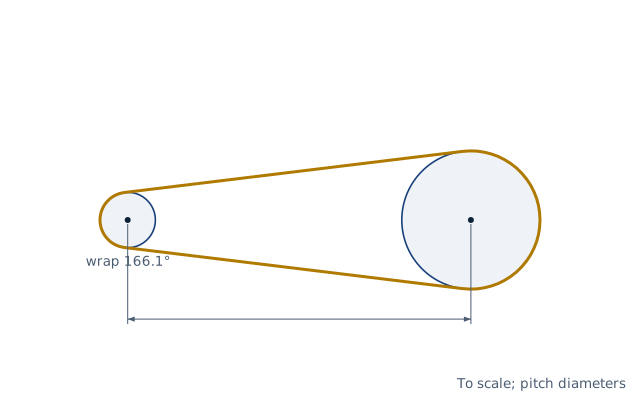
Drawn for the default inputs. It redraws as you change them.
Results are estimates. They do not replace the governing code, class or flag requirements, or a check by a competent person. Report a problem
Introduction
V-belts are sold in standard pitch lengths, so a drive design has two questions: what length fits a given centre distance, and what centre distance a standard belt gives. Shigley's approximate formula answers the first. Sheaves of 100 and 250 mm pitch diameter on 600 mm centres need a pitch length of about 1 759 mm.
This calculator gives the pitch length from the centre distance, or the centre distance for a belt length you choose from a catalogue. It shows the standard approximate result next to the exact geometry, so you can see how close the approximation is. It also gives the wrap angle on the small sheave. It is for engineers and maintenance staff selecting or replacing V-belts.
Exact open-belt length (eq. 17-1), used as the check:
φ = asin((D − d) / (2C))
L = √(4C² − (D − d)²) + ½ [D (π + 2φ) + d (π − 2φ)]
D, d — pitch diameters of the large and small sheaves
C — centre distance; L_p — belt pitch length
Wrap on the small sheave: θ = π − 2φ
Assumptions and limitations
Use pitch diameters and pitch lengths. Catalogues may also list inside or outside lengths, which differ from the pitch length by an amount that depends on the belt section.
The approximate formula keeps only the first terms of a series. For normal drives it is within a fraction of a millimetre; for large ratios on short centres the error reaches millimetres.
The centre distance is the nominal value with the belt fitted. Allow adjustment below it to fit the belt and above it for take-up as the belt stretches.
The drive has two sheaves and no idler. Below about 120° of wrap on the small sheave, the belt's power rating must be reduced.
Worked example
A drive has sheaves of 100 and 250 mm pitch diameter. The nearest standard belt has a pitch length of 1 800 mm. What centre distance does it give?
Term in brackets: 1 800 − π × 350 / 2 = 1 800 − 549.78 = 1 250.22 mm.
Centre distance: ¼ × (1 250.22 + 1 232.09) = 620.58 mm.
Exact geometry, solved for the same 1 800 mm: 620.57 mm.
The two answers differ by less than 0.01 mm. Set the motor base to give about 621 mm, with adjustment either side for fitting and take-up.
The worked example, drawn by the same code as the live drawing above.
FAQ
How do I measure a V-belt's length?
Read the size code printed on the belt and look it up in the maker's table. A tape round the outside of a used belt gives the outside length, which is longer than the pitch length.
What is the pitch diameter of a sheave?
The diameter at the belt's neutral layer, where it neither stretches nor shortens. It is smaller than the outside diameter of the sheave.
How accurate is the approximate formula?
For the example drive it is 0.012 mm short of the exact length. It becomes less accurate when the sheaves differ a lot and the centres are close.
What centre distance should a V-belt drive have?
Shigley suggests at least the large sheave diameter and at most three times the sum of the diameters. Longer drives can whip; shorter ones lose wrap.
What wrap angle is acceptable?
180° on equal sheaves. Below about 120° on the small sheave, the power a belt can carry falls and slip becomes likely.
How do I find the belt length for a new drive?
Choose the centre distance, calculate the pitch length, pick the nearest standard length, then recalculate the centre distance for that belt.
Before every release the calculator must reproduce each case below. The note under each case says where the expected answer comes from: a standard, a textbook, a published table, or a hand calculation shown in full.
Sheaves 100 and 250 mm on 600 mm centres: L_p = 1 200 + 549.779 + 9.375 = 1 759.154 mm; exact 1 759.166 mmShigley's Mechanical Engineering Design, 10th ed., eq. 17-16a and eq. 17-1 (hand calculation)
Centre distance for an 1 800 mm belt: ¼ {1 250.221 + √(1 250.221² − 2 × 150²)} = 620.579 mm; exact 620.573 mmShigley eq. 17-16b; exact inverse of eq. 17-1 by bisection (hand calculation)
Equal sheaves: approximate and exact formulas agree exactly, L = 2C + π dLimiting case D = d of eqs. 17-16a and 17-1
The approximation error grows with the diameter difference: 100/500 mm on 400 mm centres differs by more than 1 mmSeries truncation of eq. 17-16a against eq. 17-1
Approximate inverse is the exact inverse of the approximate length (eq. 17-16b solves 17-16a)Algebra of eqs. 17-16a and 17-16b
Too short a belt, overlapping sheaves and D smaller than d are rejectedBehaviour check: warnings and rejected inputs
Worked example of the article: the calculator reproduces 620.58 mm, 620.57 mm to the digits printedThe worked example on this page, to the digits printed
Assumptions and sources
Assumptions and limits
Diameters are sheave pitch diameters and the length is the belt pitch length, the convention of belt catalogues and of Shigley §17-3. Outside or inside lengths differ from the pitch length by an amount that depends on the belt section; take it from the belt maker.
The approximate formula replaces the exact arc geometry by the first terms of a series in (D − d)/C; its error grows with the diameter difference and is shown next to the exact value.
The centre distance for a standard belt is the nominal value with the belt fitted; drives need adjustment for installation (shorter) and take-up (longer), usually given by the belt maker.
Two-sheave open drive with no idler; the wrap angle on the small sheave is shown, and below about 120° the belt rating must be reduced.
Sources
Budynas and Nisbett, Shigley's Mechanical Engineering Design, 10th ed., §17-3 V belts, eqs. 17-16a and 17-16b (pitch length and centre distance), and eq. 17-1 (exact open-belt geometry)
ISO 4184:1992, Belt drives — Classical and narrow V-belts — Lengths in datum system (standard datum lengths)
Cite this calculator
Papandreou, C. (2026). V-belt length and centre distance calculator. Engineering Bible. https://engineeringbible.com/mechanical/v-belt-length/
Embed this calculator on your site
Copy this HTML into your page. The calculator stays free to use and links back here.