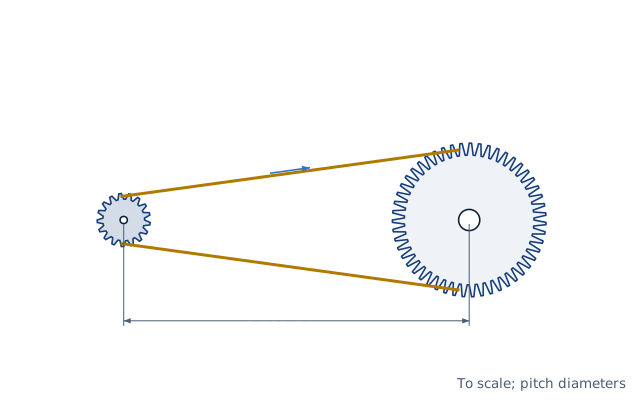
Drawn for the default inputs. It redraws as you change them.
Results are estimates. They do not replace the governing code, class or flag requirements, or a check by a competent person. Report a problem
Introduction
A roller chain drive changes speed in the ratio of the sprocket tooth counts. A 17-tooth sprocket at 900 rpm driving a 51-tooth sprocket turns it at 300 rpm. The chain must have a whole number of links, and an even number avoids a weak offset link. So the chain length is rounded up, and the centre distance moves slightly to suit.
This calculator gives the ratio, the output speed and the chain speed, the chain length in pitches for the centre distance you want, the even length to buy, and the actual centre distance with that chain. It also gives the pitch diameter of each sprocket and the chordal speed variation. It is for designers and maintenance staff laying out or replacing chain drives on conveyors, machines and motorcycles.
Formulas
Sprocket pitch diameter and chain speed:
D = p / sin(180° / N)
V = N₁ p n₁
Chain length in pitches for a centre distance C (Shigley eq. 17-27):
L/p = 2C/p + (N₁ + N₂)/2 + (N₂ − N₁)² / (4π² C/p)
Centre distance for a chain of L/p pitches (eq. 17-28):
A = (N₁ + N₂)/2 − L/p
C = (p/4) [−A + √(A² − 8 ((N₂ − N₁) / (2π))²)]
Chordal speed variation:
ΔV/V = (π/N) [1/sin(180°/N) − 1/tan(180°/N)]
p — chain pitch; N₁, N₂ — teeth on the driver and driven sprockets
n₁ — driver speed; L — chain length; C — centre distance
Assumptions and limitations
ANSI chain numbers give the pitch in eighths of an inch: No. 40 is 1/2 in (12.7 mm), No. 60 is 3/4 in. ISO B-series chains of the same pitch use the same geometry.
The chain length is rounded up to an even number of pitches, so no offset link is needed.
The centre distance is nominal, with the chain just taut. Provide adjustment or a tensioner, because chains elongate as their joints wear.
Power rating, lubrication and the number of strands are not checked. Use the chain maker's rating tables.
Worked example
A No. 40 chain (12.7 mm pitch) drives from a 17-tooth sprocket at 900 rpm to a 51-tooth sprocket. The centres are to be about 500 mm.
Ratio: 51 / 17 = 3, so the output turns at 300 rpm.
Before every release the calculator must reproduce each case below. The note under each case says where the expected answer comes from: a standard, a textbook, a published table, or a hand calculation shown in full.
2 : 1 drive, 17 and 34 teeth, C = 25 pitches: L/p = 50 + 25.5 + 0.293 = 75.79 → 76 pitches; actual C = 25.104 pitchesShigley's Mechanical Engineering Design, 10th ed., eqs. 17-27 and 17-28 (hand calculation with the data of the §17-5 design example)
Pitch diameter D = p / sin(180°/N): 1/2 in chain, 17 teeth = 2.721 in; 51 teeth = 8.122 inShigley eq. 17-25 (hand calculation)
Equal sprockets: L/p = 2C/p + N exactly, and the centre distance inverts it; an exact even length keeps CLimiting case N₁ = N₂ of eqs. 17-27 and 17-28
Chordal speed variation: 1 − cos(180°/N) over N sin(180°/N)/π; 17 teeth 1.71 %, 25 teeth 0.79 %Shigley §17-5, chordal speed variation of a roller chain (derived from V_max = rω, V_min = rω cos(180°/N))
Small sprockets warn; overlapping sprockets, fractional tooth counts and unknown chain sizes are rejectedBehaviour check: warnings and rejected inputs
Worked example of the article: the calculator reproduces 113.48, 114, 503.3 mm, 69.12 mm, 206.30 mm, 3.24 m/s to the digits printedThe worked example on this page, to the digits printed
Assumptions and sources
Assumptions and limits
Standard roller chain of pitch p on two sprockets in one plane; ANSI chain numbers give the pitch in eighths of an inch (No. 40 = 1/2 in). ISO 606 B-series chains of the same pitch use the same geometry.
The chain length in pitches follows Shigley eq. 17-27 and is rounded up to the next even number, so that no offset (cranked) link is needed; the actual centre distance for that length follows eq. 17-28.
The centre distance is nominal with the chain just taut; provide adjustment or an idler for wear elongation and sag.
The chordal speed variation is the change in chain speed as each link seats on the small sprocket; it falls quickly as the tooth count rises.
Power capacity, lubrication and the number of strands are not checked here; use the ANSI or ISO power-rating tables of the chain maker.
Sources
Budynas and Nisbett, Shigley's Mechanical Engineering Design, 10th ed., §17-5 Roller chain, eqs. 17-25 to 17-28 (pitch diameter, chain velocity, length in pitches, centre distance)
ASME B29.100, Precision power transmission, double-pitch power transmission, and double-pitch conveyor roller chains, attachments and sprockets (standard chain numbers and pitches)
Renold, Roller chain design guide: chain length and centre distance calculation
Cite this calculator
Papandreou, C. (2026). Chain and sprocket calculator (roller chain length). Engineering Bible. https://engineeringbible.com/mechanical/chain-sprocket/
Embed this calculator on your site
Copy this HTML into your page. The calculator stays free to use and links back here.