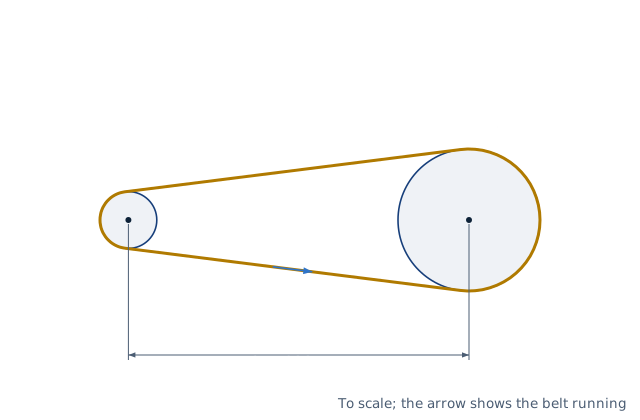
Drawn for the default inputs. It redraws as you change them.
Results are estimates. They do not replace the governing code, class or flag requirements, or a check by a competent person. Report a problem
Introduction
A belt drive changes speed in the ratio of its pulley diameters. A 100 mm pulley on a 1 450 rpm motor driving a 250 mm pulley turns it at 1 450 × 100 / 250 = 580 rpm, a ratio of 2.5. The torque rises by nearly the same ratio, less the small belt losses.
This calculator gives the speed ratio, the driven speed with optional slip, the belt speed, and the exact length of an open or crossed belt from the pulley diameters and the centre distance. It also gives the wrap angle on each pulley and the free span. It is for anyone designing or replacing a belt drive on a fan, pump, machine tool or workshop machine.
Formulas
Speeds:
i = d₂ / d₁, n₂ = n₁ d₁ / d₂ × (1 − s), v = π d₁ n₁
Open belt, with D the larger and d the smaller diameter:
d₁, n₁ — driver diameter and speed; d₂, n₂ — driven diameter and speed
C — centre distance; s — slip; v — belt speed
θ — wrap angle in radians; L — belt length on the pitch line
Assumptions and limitations
Use the diameter on which the belt actually runs. For V-belts and timing belts this is the pitch diameter, for flat belts the outside diameter plus the belt thickness.
The length is exact for straight spans and circular arcs. It ignores sag, stretch and the take-up allowance needed to fit the belt.
Friction belts creep slightly, typically 1 to 2 %. Enter that as slip if the exact driven speed matters. Timing belts and chains do not slip.
A wrap angle below about 120° on the small pulley lets a friction belt slip. The calculator warns below that value.
Worked example
A motor at 1 450 rpm drives a fan with a 100 mm pulley on the motor and a 250 mm pulley on the fan. The centre distance is 600 mm. Find the fan speed and the belt length.
Ratio: 250 / 100 = 2.500.
Fan speed: 1 450 / 2.5 = 580 rpm.
Belt speed: π × 0.100 × 1 450 / 60 = 7.59 m/s.
Angle φ = asin(150 / 1 200) = 0.1253 rad, so the motor pulley has a wrap of π − 0.2507 = 2.891 rad, or 165.6 degrees.
A crossed belt on the same pulleys would be 1 801 mm long and turn the fan the other way.
The worked example, drawn by the same code as the live drawing above.
FAQ
How do I calculate pulley rpm?
Multiply the driver speed by the driver diameter and divide by the driven diameter. A 1 750 rpm motor with a 3 in pulley driving a 6 in pulley gives 875 rpm.
How do I work out the belt length?
Use the exact formula above, or measure around both pulleys with a tape on the belt's running line. For V-belts, use the pitch length the belt maker lists.
Does a bigger pulley make the driven shaft faster?
A bigger pulley on the driver does. A bigger pulley on the driven shaft makes it slower and increases its torque.
What is the minimum wrap angle?
About 120° on the small pulley for flat and V-belts. Below that, increase the centre distance, reduce the ratio, or add an idler.
What is the difference between an open and a crossed belt?
An open belt turns both pulleys the same way. A crossed belt reverses the driven pulley and wraps more of each pulley, but it rubs where it crosses.
How fast does the belt run?
v = π d n. The example belt runs at 7.59 m/s, about 1 500 ft/min.
Before every release the calculator must reproduce each case below. The note under each case says where the expected answer comes from: a standard, a textbook, a published table, or a hand calculation shown in full.
Open belt 100/250 mm on 600 mm centres at 1 450 rpm: ratio 2.5, 580 rpm, 7.592 m/s, wrap 165.64°, L = 1 759.17 mmShigley's Mechanical Engineering Design, 10th ed., eq. 17-1 (hand calculation)
Crossed belt, same pulleys: wrap 213.92° on both, L = √(1.44 − 0.1225) + 0.175 × 3.7335 = 1 801.19 mmShigley eq. 17-1, crossed belt (hand calculation)
Equal pulleys: open length is 2C + π d and both wraps are 180°Limiting case of eq. 17-1 with D = d
Slip: 2 % slip lowers 580 rpm to 568.4 rpm; swapping driver and driven gives the inverse ratio and the same belt lengthn₂ = n₁ d₁/d₂ (1 − s); the belt geometry is symmetric in the two pulleys
A short centre distance warns of low wrap (100/400 mm on 280 mm: 115°); overlapping pulleys and zero speed are rejectedBehaviour check: warnings and rejected inputs
Worked example of the article: the calculator reproduces 2.500, 580 rpm, 7.59 m/s, 1 759 mm to the digits printedThe worked example on this page, to the digits printed
Assumptions and sources
Assumptions and limits
Diameters are the effective (pitch) diameters on which the belt runs: the outside diameter plus the belt thickness for a flat belt, the pitch diameter for V-belts and timing belts.
The belt length uses the exact geometry of two circles joined by straight spans (Shigley eq. 17-1); belt sag, stretch and installation allowance are not included.
The driven speed is n₁ d₁/d₂ reduced by the slip entered; flat and V-belts typically creep 1 to 2 %, timing belts do not slip.
A wrap angle on the small pulley below about 120° limits the torque a friction belt can transmit; the calculator warns below 120°.
Sources
Budynas and Nisbett, Shigley's Mechanical Engineering Design, 10th ed., §17-2 Flat and round belts, eq. 17-1 (open and crossed belt geometry)
Oberg et al., Machinery's Handbook, 31st ed., Belts and pulleys: pulley speeds and belt length formulas
Cite this calculator
Papandreou, C. (2026). Belt and pulley calculator (ratio, rpm, belt length). Engineering Bible. https://engineeringbible.com/mechanical/belt-pulley/
Embed this calculator on your site
Copy this HTML into your page. The calculator stays free to use and links back here.