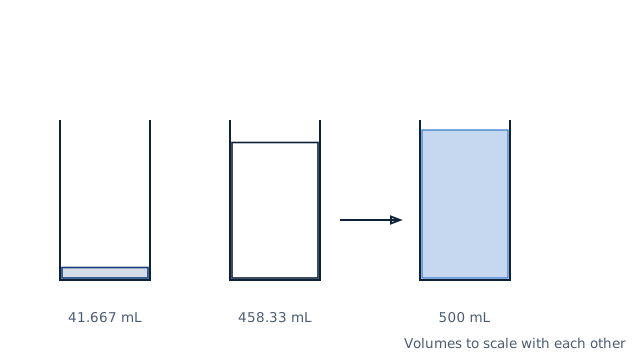
Drawn for the default inputs. It redraws as you change them.
Results are estimates. They do not replace the governing code, class or flag requirements, or a check by a competent person. Report a problem
Introduction
When you dilute a solution, the amount of solute stays the same and only the volume grows. That gives the dilution formula C1V1 = C2V2: stock concentration times stock volume equals final concentration times final volume. To make 500 mL of 1 M hydrochloric acid from a 12 M stock, take 1 × 500 / 12 = 41.67 mL of stock and make it up to 500 mL. The dilution factor is C1 / C2, here 12.
This calculator solves C1V1 = C2V2 for any one of the four terms. It gives the dilution factor, the volume of diluent to add and the stock-to-diluent ratio. It also plans a serial dilution of equal steps, with the total factor and the concentration after each step. It is for laboratory staff, microbiologists, students and process operators making working solutions and standards.
C2, V2 — concentration and final volume of the diluted solution
f — factor per step; n — number of steps; v_transfer — volume moved from tube to tube
Assumptions and limitations
C1 and C2 must be in the same unit: mol/L, mg/L, % w/v, ppm or cells/mL all work.
V2 is the final volume after making up. Adding V2 − V1 of diluent gives the same result only when volumes add, which is close for dilute aqueous solutions.
Concentrated acids, alcohols and other mixtures that shrink or swell on mixing should be made up to the mark in a volumetric flask.
Concentrations by mass, such as % w/w, dilute by mass. Use masses instead of volumes for them.
Large single-step dilutions need tiny stock volumes that are hard to measure. Beyond about 1 : 1 000, a serial dilution is more accurate.
Worked example
A technician needs 500 mL of 1 M hydrochloric acid and has a 12 M stock.
Stock volume: V1 = 1 × 500 / 12 = 41.67 mL.
Diluent: 500 − 41.67 = 458.3 mL of water.
Dilution factor: 12 / 1 = 12.0, a ratio of 1 : 11.
Put about 400 mL of water in the flask, add the acid slowly, then make up to 500 mL once it has cooled.
The worked example, drawn by the same code as the live drawing above.
FAQ
How do you use C1V1 = C2V2?
Fill in the three values you know and solve for the fourth. To dilute 10 mL of 0.5 M stock to 250 mL, C2 = 0.5 × 10 / 250 = 0.02 M.
What is a dilution factor?
The ratio of the stock concentration to the final concentration, or of the final volume to the stock volume. A 1 mL sample made up to 100 mL has a dilution factor of 100.
What is the difference between 1 : 10 and 1 in 10?
"1 in 10" usually means 1 part in a total of 10 parts, a factor of 10. "1 : 10" often means 1 part stock to 10 parts diluent, a factor of 11. State which you mean.
How do I make a serial dilution?
Transfer a fixed volume into a tube holding (f − 1) times that volume of diluent, mix, and repeat. Six 1 : 10 steps with 1 mL transfers and 9 mL of diluent give a factor of one million.
Why use a serial dilution instead of one big dilution?
Making 100 mL of a millionfold dilution in one step needs 0.1 µL of stock, which cannot be measured accurately. Several moderate steps keep every volume measurable and accurate.
Does C1V1 = C2V2 work for mass concentrations?
Use masses instead of volumes for % w/w or mg/kg. With volumes it is exact only when the density does not change on dilution.
Related calculators
Molarity — preparing the stock solution from a solid.
Before every release the calculator must reproduce each case below. The note under each case says where the expected answer comes from: a standard, a textbook, a published table, or a hand calculation shown in full.
500 mL of 1 M HCl from 12 M stock: 41.67 mL of stock, 458.3 mL of water, dilution factor 12 (1 : 11)Harris, Quantitative Chemical Analysis, ch. 1: M_conc V_conc = M_dil V_dil, by hand
Each unknown in turn: 10 mL of 0.5 M made up to 250 mL is 0.02 M; 10 mL of 2 M to 0.1 M needs 200 mL; 0.02 M from 10 mL into 250 mL means 0.5 M stockC1V1 = C2V2 rearranged, by hand
Serial: six 1 : 10 steps from 10⁸ cells/mL give a factor of 10⁶ and 100 cells/mL; 1 mL transfers need 9 mL of diluent per tubeSerial dilution, DF_total = f^n (Skoog et al., ch. 4), by hand
Two-fold series: 5 steps of 1 : 2 is a factor of 32; a one-step factor of 1 leaves the concentration unchanged with no diluentLimiting cases by hand
A final concentration above the stock, a final volume below the stock volume and a fractional step count are rejected; a large one-step factor warnsBehaviour check: warnings and rejected inputs
Worked example of the article: the calculator reproduces 41.67 mL, 458.3 mL, 12.0 to the digits printedThe worked example on this page, to the digits printed
Assumptions and sources
Assumptions and limits
The amount of solute is conserved: what is taken from the stock ends up in the final solution, so C1 V1 = C2 V2 in any consistent concentration unit (mol/L, mg/L, % w/v, cells/mL).
V2 is the final volume after making up, not the volume of diluent added; the diluent is V2 − V1 when volumes are additive, which holds closely for dilute aqueous solutions but not for concentrated acids or alcohol and water.
Mass-based concentrations (% w/w, mg/kg) dilute exactly by mass, not by volume; use masses in place of volumes for them, or convert with the densities.
Serial dilution uses equal steps: each tube receives the transfer volume from the previous one and (f − 1) times that volume of diluent, mixed before the next transfer.
Sources
Harris, D.C., Quantitative Chemical Analysis, 9th ed., W.H. Freeman, ch. 1 (dilution formula M_conc V_conc = M_dil V_dil)
Skoog, D.A., West, D.M., Holler, F.J. and Crouch, S.R., Fundamentals of Analytical Chemistry, 9th ed., ch. 4 (preparing solutions by dilution)
Cite this calculator
Papandreou, C. (2026). Dilution calculator (C1V1 = C2V2 and serial dilution). Engineering Bible. https://engineeringbible.com/process/dilution/
Embed this calculator on your site
Copy this HTML into your page. The calculator stays free to use and links back here.