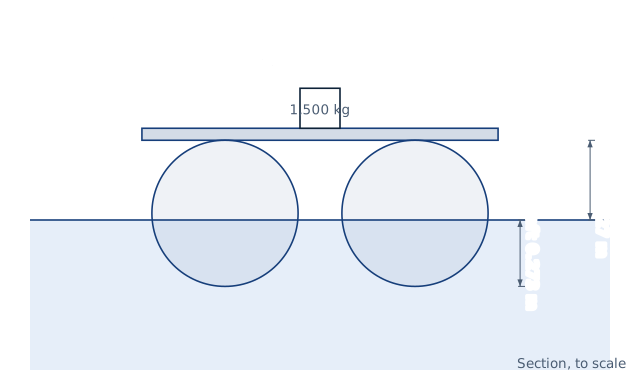
Drawn for the default inputs. It redraws as you change them.
Results are estimates. They do not replace the governing code, class or flag requirements, or a check by a competent person. Report a problem
Introduction
A body in water is pushed up by a force equal to the weight of the water it displaces. That is Archimedes' principle: buoyant force = water density × gravity × displaced volume. A sealed 0.2 m³ drum held under sea water is pushed up with 1 025 × 9.81 × 0.2 = 2 010 N, enough to support 205 kg. If the body weighs less than that, it floats and sinks only until it displaces its own weight.
This calculator gives the buoyant force, the net force and whether an object floats in fresh or sea water. For boxes, upright cylinders and horizontal cylinders such as pontoon tubes and drums, it gives the draught and freeboard, and the load the floats can carry while keeping a chosen freeboard. It is for boaters, raft and jetty builders, divers and students.
Formulas
Archimedes' principle:
F_B = ρ g V
floats when m < ρ V,     share under water = m / (ρ V)
Draught of n identical floats carrying a total mass m:
box:                  T = m / (ρ n L B)
upright cylinder:     T = m / (ρ n π D² / 4)
horizontal cylinder:  ρ n L A(T) = m
A(T) = r² acos((r − T) / r) − (r − T) √(2 r T − T²)
Payload to a freeboard f, for floats of height H:
m_max = ρ n × (volume immersed to H − f)
ρ — water density: 1 000 kg/m³ fresh, 1 025 kg/m³ sea; g = 9.81 m/s²
V — volume of the body; r = D/2 — radius of a cylinder; A — submerged segment area
Assumptions and limitations
The floats are rigid and watertight, the water is still, and the load is shared equally so the floats sit level.
Stability is not checked. A raft can have plenty of buoyancy and still capsize if it is narrow or the load is high.
The ends of a horizontal cylinder are taken as flat. Rounded or pointed pontoon ends add a little volume.
Keep a working margin beyond the freeboard limit for people moving about, waves and water on deck.
Worked example
A small raft floats on two pontoon tubes, each 0.6 m in diameter and 6 m long, in fresh water. Tubes, deck and people together weigh 1 500 kg. How deep do the tubes sink, and how much can the raft carry with 0.15 m of freeboard?
Volume of the two tubes: 2 × π × 0.3² × 6 = 3.39 m³, so they can never carry more than 3 393 kg.
Each tube carries 750 kg, which needs 0.75 m³ of displaced water: 0.75 / 6 = 0.125 m² of submerged section.
Solving the segment area for 0.125 m² gives a draught of 0.273 m, leaving 0.327 m of freeboard.
With 0.15 m freeboard the tubes are immersed 0.45 m. The segment area is then 0.2275 m², so the tubes carry 2 × 0.2275 × 6 × 1 000 = 2 730 kg.
Extra payload: 2 730 − 1 500 = 1 230 kg.
The worked example, drawn by the same code as the live drawing above.
FAQ
How do I calculate buoyant force?
Multiply the water density by gravity and by the volume under water. One cubic metre fully submerged in fresh water gives 9.81 kN, enough to support 1 000 kg.
How do I know if an object will float?
Compare its mass with the mass of water it would displace fully submerged. A steel block sinks, but a steel hull floats because it encloses far more volume than its steel.
How much weight can a 55 gallon drum hold up?
A 55 US gallon drum holds 0.208 m³, so fully submerged it supports 208 kg in fresh water or 213 kg in sea water, less the drum's own mass.
Do things float better in sea water?
Yes. Sea water is about 2.5 % denser than fresh water, so the same float carries 2.5 % more, or floats a little higher with the same load.
Does a submerged object get more buoyant deeper down?
Not if it is rigid: the displaced volume, and so the force, stays the same. Bodies that compress, such as foam, air pockets or a diver's suit, lose buoyancy with depth.
Why keep a freeboard on a raft or pontoon?
A float loaded to the waterline has no reserve for waves, wake or people stepping to one side. The reserve buoyancy above the water is what keeps the deck dry and the raft upright.
Before every release the calculator must reproduce each case below. The note under each case says where the expected answer comes from: a standard, a textbook, a published table, or a hand calculation shown in full.
A 0.2 m³ body of 150 kg in sea water: buoyancy 1 025 × 9.80665 × 0.2 = 2 010.4 N, net +539.4 N, floats 73.2 % immersedArchimedes' principle (White, Fluid Mechanics §2.8); hand calculation
Box 6 × 2 × 1 m carrying 2 000 kg in sea water floats at 2 000 / (1 025 × 12) = 0.163 mT = m / (ρ L B) (Derrett & Barrass, box-shaped vessels); hand calculation
Horizontal cylinder: half immersed carries half its volume; two 0.6 m × 6 m tubes with 1 500 kg float at 0.273 mCircular segment area r² acos((r − h)/r) − (r − h)√(2rh − h²); hand calculation
Upright drum 0.57 m diameter: 100 kg in fresh water sinks 100 / (1 000 × 0.2552) = 0.392 mT = m / (ρ π D²/4); hand calculation
Too heavy sinks with a warning; a freeboard taller than the float and a fractional count are rejectedBehaviour check: warnings and rejected inputs
Worked example of the article: the calculator reproduces 3.39 m³, 0.273 m, 2 730 kg, 1 230 kg to the digits printedThe worked example on this page, to the digits printed
Assumptions and sources
Assumptions and limits
Archimedes' principle: the upward force equals the weight of the water displaced, ρ g V. The body is rigid and watertight, and the water is still.
Sea water is taken as 1 025 kg/m³ and fresh water as 1 000 kg/m³; brackish dock water lies in between and can be entered as another density.
The floating body floats upright and level, with its weight shared equally by the floats. Stability against capsizing is not checked: a tall narrow float can be buoyant enough and still roll over.
For a horizontal cylinder the end caps are ignored: the submerged volume is the segment area × length. Rounded or conical ends of real pontoons add a little volume.
The payload is what the floats can support down to the required freeboard; a working margin is still needed for people moving about, waves and water shipped on deck.
Sources
Archimedes' principle as stated in F.M. White, Fluid Mechanics, 8th ed. (McGraw-Hill, 2016), §2.8 Buoyancy and stability
Derrett, D.R. and Barrass, C.B., Ship Stability for Masters and Mates, 7th ed. (2012), ch. 1–2: displacement, density and the draught of box-shaped vessels
ITTC Recommended Procedure 7.5-02-01-03, Fresh water and seawater properties (2011): standard sea water of 35 g/kg is 1 026 kg/m³ at 15 °C and 1 025 kg/m³ at about 19 °C
Cite this calculator
Papandreou, C. (2026). Buoyancy calculator (Archimedes). Engineering Bible. https://engineeringbible.com/maritime/buoyancy/
Embed this calculator on your site
Copy this HTML into your page. The calculator stays free to use and links back here.