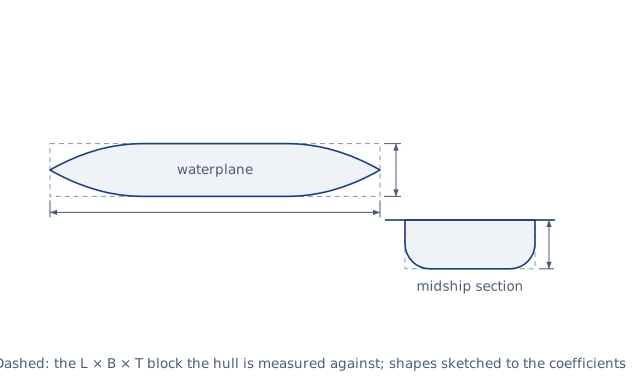
Drawn for the default inputs. It redraws as you change them.
Results are estimates. They do not replace the governing code, class or flag requirements, or a check by a competent person. Report a problem
Introduction
The block coefficient says how much of the box around the underwater hull the hull actually fills. It is the displacement volume divided by length × breadth × draught. A ship 100 m long, 16 m wide and 6 m deep in the water that displaces 7 200 m³ fills 7 200 of the 9 600 m³ box, so C_B = 0.750. A barge comes close to 1, a fast yacht can be below 0.4.
This calculator gives the block coefficient and the other hull form coefficients: midship, prismatic, waterplane and vertical prismatic. It takes the underwater volume directly, from the displacement in tonnes, or from a known C_B, and gives the displacement in salt and fresh water and the TPC. It is for deck officers, cadets and naval architecture students working with hydrostatics.
L — length between perpendiculars or on the waterline; B — moulded breadth; T — moulded draught
∇ — displacement volume; A_M — midship section area below the waterline; A_WP — waterplane area
ρ — water density: 1.025 t/m³ for salt water, 1.000 t/m³ for fresh water
Assumptions and limitations
All coefficients belong to one draught. They fall as the ship rises, so design-draught values overstate the displacement at ballast draught.
Coefficients based on L_PP and on L_WL differ. Compare like with like.
The volume is moulded, inside the plating and without appendages. Shell plating, rudder and propeller add a little to a steel ship's displacement.
The hull-type hint uses the typical block coefficients MAN Energy Solutions lists for merchant ships.
Worked example
A coaster is 100 m long, 16 m in breadth and floats at 6 m draught. Its displacement volume is 7 200 m³, the midship section area 92 m² and the waterplane area 1 300 m².
Displacement: 7 200 × 1.025 = 7 380 t in salt water, or 7 200 t in fresh water. TPC in salt water is 1 300 × 1.025 / 100 = 13.3 t/cm.
The worked example, drawn by the same code as the live drawing above.
FAQ
What is a typical block coefficient?
MAN lists about 0.80 to 0.85 for tankers and bulk carriers, 0.55 to 0.75 for general cargo ships, 0.50 to 0.70 for container ships and ferries, and 0.90 for lighters.
How do I calculate displacement from the block coefficient?
Multiply C_B by length, breadth, draught and water density. A ship 180 m × 32 m × 10 m with C_B 0.80 displaces 0.80 × 57 600 × 1.025 = 47 232 t in salt water.
What is the difference between the block and the prismatic coefficient?
The block coefficient compares the hull with a box. The prismatic coefficient compares it with a prism of the midship section, so it shows how the volume is spread along the length, which matters for wave resistance.
What is the waterplane coefficient used for?
It gives the waterplane area, and from that the TPC: the tonnes needed to sink the ship one centimetre.
Why is the displacement less in fresh water?
It is the same underwater volume filled with lighter water: 1.000 t/m³ against 1.025 t/m³. The same ship, with the same mass, floats deeper in fresh water instead.
Can the block coefficient be more than 1?
No. If the calculator says so, the volume or a dimension is wrong, often a draught entered in feet as metres.
Before every release the calculator must reproduce each case below. The note under each case says where the expected answer comes from: a standard, a textbook, a published table, or a hand calculation shown in full.
100 × 16 × 6 m, ∇ 7 200 m³, A_M 92 m², A_WP 1 300 m²: C_B 0.750, C_M 0.958, C_P 0.783, C_WP 0.813, C_VP 0.923Derrett & Barrass, Ship Stability for Masters and Mates, ch. 2 (definitions); hand calculation
Displacement: 7 200 m³ is 7 380 t in salt water (1.025) and 7 200 t in fresh water; TPC = 1 300 × 1.025 / 100 = 13.33 t/cmΔ = ∇ ρ; TPC = A_WP ρ / 100 (Derrett & Barrass ch. 9)
From mass: 1 800 t in salt water on 64 × 10 × 4 m gives C_B = 1 800 / (1.025 × 2 560) = 0.686C_B = Δ / (ρ L B T); hand calculation in the form of Derrett & Barrass ch. 2 exercises
A box barge has every coefficient equal to 1; from C_B, Δ = C_B L B T ρLimiting case of the definitions
A volume larger than L B T and a midship area larger than B T are rejectedBehaviour check: warnings and rejected inputs
Worked example of the article: the calculator reproduces 0.750, 0.958, 0.783, 0.813, 0.923, 7 380 t, 7 200 t to the digits printedThe worked example on this page, to the digits printed
Assumptions and sources
Assumptions and limits
L, B and T are the length, breadth and draught at the waterline of the condition considered (for ships usually L_PP, moulded breadth and moulded draught). Coefficients from different length definitions are not comparable.
The coefficients describe the underwater hull at that draught; they fall as the draught decreases, so design values do not apply at ballast draught.
The displacement volume ∇ is moulded (inside the shell plating, without appendages). The displacement of the shell plating and appendages (rudder, propeller, bilge keels) comes on top.
Salt water is taken as 1.025 t/m³ and fresh water as 1.000 t/m³, the values of the load line rules; other densities can be entered.
Sources
Derrett, D.R. and Barrass, C.B., Ship Stability for Masters and Mates, 7th ed. (Butterworth-Heinemann, 2012), ch. 2: form coefficients C_B, C_M, C_P, C_W
Lewis, E.V. (ed.), Principles of Naval Architecture, 2nd rev. (SNAME, 1988), Vol. I ch. 1: hull form coefficients
International Convention on Load Lines 1966, Annex I: sea water density 1.025 t/m³ for the fresh water allowance
MAN Energy Solutions, Basic Principles of Ship Propulsion (2018): examples of block coefficients by ship type
Cite this calculator
Papandreou, C. (2026). Block coefficient and hull form coefficients calculator. Engineering Bible. https://engineeringbible.com/maritime/block-coefficient/
Embed this calculator on your site
Copy this HTML into your page. The calculator stays free to use and links back here.