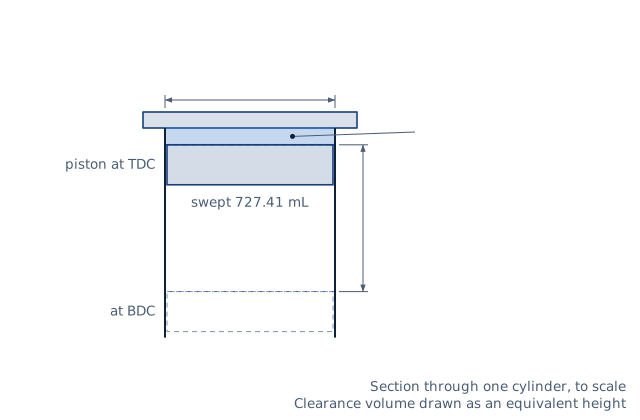
Drawn for the default inputs. It redraws as you change them.
Results are estimates. They do not replace the governing code, class or flag requirements, or a check by a competent person. Report a problem
Introduction
The compression ratio of an engine is the volume above the piston at the bottom of its stroke divided by the volume at the top. To calculate it, add the swept volume of one cylinder to its clearance volume and divide by the clearance volume. A 350 small-block with a 4.030 in bore, 64 cc heads and a flat-top piston with valve reliefs comes out at about 9.75:1.
This calculator adds up the clearance volume from the head chamber, the head gasket, the deck clearance and the piston dish or dome. It then gives the static compression ratio, each volume in cc and the engine displacement. It is for engine builders choosing heads, gaskets and pistons, and for anyone checking a build sheet.
Formulas
Volumes of one cylinder:
V_s = π/4 × b² × s
V_gasket = π/4 × b_g² × t
V_deck = π/4 × b² × d
V_c = V_chamber + V_gasket + V_deck + V_piston
Static compression ratio:
CR = (V_s + V_c) / V_c
b — cylinder bore; s — stroke
b_g — head gasket bore; t — compressed gasket thickness
d — deck clearance, positive when the piston stops below the deck
V_chamber — head chamber volume in cc
V_piston — dish and valve reliefs positive, dome negative
1 in³ = 16.387 cc
Assumptions and limitations
This is the static ratio. The intake valve closes well after bottom dead centre, so the dynamic ratio that sets cylinder pressure is lower. Cam timing matters as much as the static number.
Use the compressed gasket thickness from the gasket maker, not the free thickness of the gasket.
A piston above the deck gives a negative deck volume. The calculator stops if the piston would touch the head.
The volume beside the top ring land is not included. Measuring the chamber and piston with a burette is more accurate than catalogue figures.
Worked example
A 350 small-block is bored 0.030 in over to 4.030 in and keeps the 3.480 in stroke. The heads have 64 cc chambers. The gasket is 0.041 in thick with a 4.100 in bore. The pistons sit 0.025 in below the deck and have 5 cc of valve reliefs.
The eight cylinders displace 355.1 in³, or 5.82 L. A gasket 0.015 in thinner would raise the ratio to about 10.1:1.
The worked example, drawn by the same code as the live drawing above.
FAQ
How do I calculate compression ratio?
Divide the swept volume plus the clearance volume by the clearance volume. The clearance volume is the chamber, gasket, deck and piston volumes added together.
What compression ratio can I run on pump gas?
It depends on the cam timing, the chamber shape, the cooling and the fuel octane. Ask the piston or cam maker for the ratio that suits the combination.
How does a thinner head gasket change compression?
It reduces the clearance volume. In the example, each 0.010 in of gasket thickness on a 4.100 in gasket bore is about 2.2 cc.
Is a dome positive or negative?
Enter a dome as a negative volume, because it fills part of the chamber. Enter a dish and valve reliefs as positive volumes.
What is the difference between static and dynamic compression ratio?
The static ratio uses the full stroke. The dynamic ratio uses only the stroke after the intake valve closes, so it is always lower.
What is deck clearance?
The distance from the piston crown at top dead centre to the block deck. Adding it to the gasket thickness gives the piston-to-head distance.
Before every release the calculator must reproduce each case below. The note under each case says where the expected answer comes from: a standard, a textbook, a published table, or a hand calculation shown in full.
4.030 × 3.480 in, 64 cc chamber, 0.041 in gasket of 4.100 in, 0.025 in deck, 5 cc reliefs: 727.4 cc swept, 83.1 cc clearance, 9.75:1Hand calculation: π/4 b² s = 44.389 in³ = 727.41 cc; gasket π/4 × 4.1² × 0.041 = 0.5413 in³ = 8.870 cc; deck 0.3189 in³ = 5.226 cc
Chevrolet 350: 4.000 in bore × 3.480 in stroke × 8 is 349.9 in³ (5.73 L)Published GM small-block 350 dimensions (4.00 in × 3.48 in, 350 cu in, 5.7 L)
Chamber only (no gasket, deck or dish): 86 × 86 mm with 50 cc gives (499.6 + 50) / 50 = 10.99Limiting case of r_c = (V_d + V_c) / V_c (Heywood Section 2.2)
A 5 cc dome instead of 5 cc of reliefs removes 10 cc of clearance and raises the ratio to 10.95Sign convention of the piston volume (dome negative); hand calculation (810.508 − 10) / 73.096
Piston above the deck by more than the gasket, or a dome larger than the clearance, is rejected; a small gasket bore warnsBehaviour check: warnings and rejected inputs
Worked example of the article: the calculator reproduces 727.4 mL, 8.87 mL, 5.23 mL, 83.1 mL, 9.75, 355.1 in³ to the digits printedThe worked example on this page, to the digits printed
Assumptions and sources
Assumptions and limits
The static compression ratio is the cylinder volume at bottom dead centre divided by the volume at top dead centre, CR = (V_s + V_c) / V_c; it ignores valve timing, so the dynamic (effective) ratio with a late-closing intake valve is lower.
The head gasket is treated as a cylinder of its compressed thickness and its bore diameter; use the compressed thickness from the gasket maker, not the free thickness.
The deck volume is a cylinder of the bore diameter and the deck clearance: positive when the piston crown stops below the block deck at top dead centre, negative when it rises above it.
The piston volume is positive for a dish and valve reliefs (they add clearance volume) and negative for a dome (it fills the chamber); the small volume beside the top ring land is not included.
Chamber and piston volumes are entered in cc (1 cc = 1 mL); measure them with a burette for an accurate ratio.