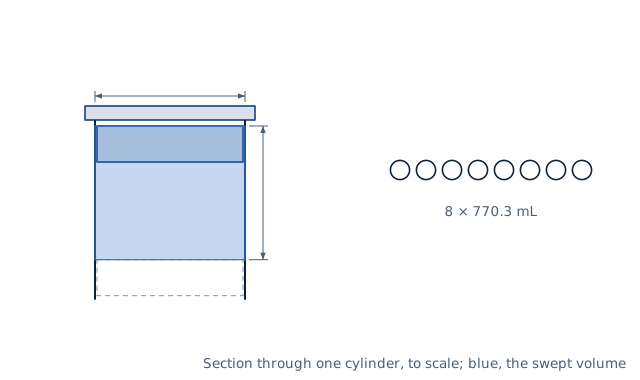
Drawn for the default inputs. It redraws as you change them.
Results are estimates. They do not replace the governing code, class or flag requirements, or a check by a competent person. Report a problem
Introduction
Engine displacement is the volume all the pistons sweep in one revolution of the crank, from bottom to top of their stroke. To calculate it, multiply the area of one bore by the stroke and by the number of cylinders. A GM LS3 V8 has a 4.065 in bore and a 3.622 in stroke, which gives 376 cubic inches or 6.2 litres.
This calculator gives the displacement in cubic inches, litres and cc from the bore, stroke and cylinder count. It also works backwards to the bore or stroke for a target size, and gives the bore/stroke ratio and the mean piston speed. It is for engine builders planning a stroker or an overbore, and for anyone converting between cubic inches and litres.
Formulas
Displacement and its inverses:
V = π/4 × b² × s × n
b = √(4 V / (π s n))
s = 4 V / (π b² n)
Mean piston speed:
S_p = 2 × s × N
b — bore; s — stroke; n — number of cylinders
N — engine speed in revolutions per minute
1 in³ = 16.387 cc; 1 L = 61.02 in³
Assumptions and limitations
The formula holds for any piston engine, four-stroke or two-stroke. It does not apply to rotary engines.
Add any overbore to the bore before calculating. A 0.030 in overbore on a 350 adds about 5 in³.
Badge sizes are rounded. GM sells the 5 733 cc small-block as a 5.7.
The mean piston speed is an average over a revolution. The piston moves about 1.6 times faster near mid-stroke.
Worked example
A GM LS3 has a 4.065 in bore, a 3.622 in stroke and eight cylinders. It revs to 6 600 rpm.
Bore area: π/4 × 4.065² = 12.978 in².
One cylinder: 12.978 × 3.622 = 47.01 in³, or 770.3 mL (cc).
Eight cylinders: 8 × 47.007 = 376.1 in³.
In litres: 376.05 × 16.387 / 1 000 = 6.16 L.
Bore/stroke ratio: 4.065 / 3.622 = 1.122, an oversquare engine.
Before every release the calculator must reproduce each case below. The note under each case says where the expected answer comes from: a standard, a textbook, a published table, or a hand calculation shown in full.
Honda K20: 86 × 86 mm, 4 cylinders is 1 998 cc; Toyota 2JZ: 86 × 86 mm, 6 cylinders is 2 997 ccHonda and Toyota published specifications (1 998 cc and 2 997 cc)
GM LS3: 4.065 × 3.622 in × 8 is 376 cu in (6.2 L); small-block 350: 4.00 × 3.48 in is 349.9 cu inGM published specifications (LS3 6.2 L / 376 cu in; 350 cu in, 5.7 L)
Inverse: 350 cu in with a 3.48 in stroke needs a 4.001 in bore; 2.0 L from an 86 mm bore and 4 cylinders needs an 86.08 mm strokeRearranged V = π/4 b² s n; consistency with the forward calculation
Mean piston speed: 3.622 in stroke at 6 600 rpm is 2 × 3.622/12 × 6 600 = 3 984 ft/min (20.24 m/s)Heywood Section 2.2, S_p = 2 L N
Fractional cylinders, zero bore and an unknown mode are rejectedBehaviour check: warnings and rejected inputs
Worked example of the article: the calculator reproduces 376.1 in³, 6.16 L, 770.3 mL, 1.122, 3 984 ft/min to the digits printedThe worked example on this page, to the digits printed
Assumptions and sources
Assumptions and limits
Displacement is the swept volume of all cylinders, π/4 × bore² × stroke × cylinders, for a four-stroke or a two-stroke piston engine alike; it does not apply to rotary (Wankel) engines.
Bore and stroke are the finished dimensions; an overbore of 0.030 in or 0.5 mm is added to the bore before calculating.
Manufacturers round displacement to the nearest 0.1 L for the badge (5 733 cc is sold as a 5.7) and sometimes to whole cubic inches.
The mean piston speed is 2 × stroke × rpm; it is the average over a revolution, and the peak speed near mid-stroke is about 1.6 times higher for usual connecting-rod lengths.
Sources
J.B. Heywood, Internal Combustion Engine Fundamentals, McGraw-Hill 1988, Section 2.2 (displaced volume V_d = π B² L / 4 and mean piston speed 2 L N)
Manufacturer data for the test engines: GM small-block 350 (4.00 × 3.48 in), GM LS3 (4.065 × 3.622 in, 6.2 L), Honda K20 (86 × 86 mm, 1 998 cc), Toyota 2JZ-GTE (86 × 86 mm, 2 997 cc)
Cite this calculator
Papandreou, C. (2026). Engine displacement calculator. Engineering Bible. https://engineeringbible.com/automotive/engine-displacement/
Embed this calculator on your site
Copy this HTML into your page. The calculator stays free to use and links back here.