Introduction
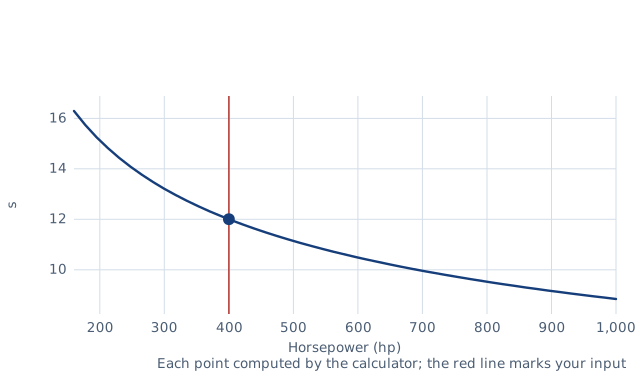
How fast will a car run the quarter mile? Drag racers estimate the elapsed time and the trap speed from the race weight and the horsepower, using formulas fitted to drag-strip results. Both depend only on the weight per horsepower. A 3 500 lb car with 400 hp carries 8.75 lb per hp and should run about 12.0 seconds at about 114 mph.
This calculator gives the estimated quarter-mile ET and trap speed with three published sets of constants, and the matching eighth-mile figures. It accepts crank or wheel horsepower. It is for enthusiasts planning a build, comparing cars, or checking whether a time slip matches the claimed power.
Formulas
Quarter-mile estimates:
ET = K_t × (W / hp)^(1/3)
mph = K_v × (hp / W)^(1/3)
Eighth mile, from the constant-power model behind the formulas:
ET_1/8 = ET_1/4 / 2^(2/3) = ET_1/4 / 1.587
mph_1/8 = mph_1/4 / 2^(1/3) = mph_1/4 / 1.260- W — race weight in lb, with driver and fuel
- hp — flywheel horsepower; wheel hp is divided by (1 − loss) first
- K_t, K_v — Hale 5.825 and 234; Fox 6.050 and 225; Huntington 6.290 and 224
Assumptions and limitations
- The formulas are estimates. They assume good traction, a prepared track and a clean launch.
- A car that spins its tyres or launches softly runs a slower ET than predicted, while its trap speed stays close to the estimate.
- Altitude and hot weather reduce engine power and slow the car. Correct the horsepower first.
- The eighth-mile ratios come from a car accelerating at constant power with no drag. Real cars differ from 1.587 by a few percent.
- The constants differ because they were fitted to different cars. Hale's suit modern performance cars.
Worked example
A street car weighs 3 500 lb with the driver and has 400 hp at the flywheel. What are its quarter-mile and eighth-mile estimates with the Hale constants?
- Weight to power: 3 500 / 400 = 8.75 lb per hp.
- Cube root: 8.75^(1/3) = 2.061.
- Elapsed time: 5.825 × 2.061 = 12.00 s.
- Trap speed: 234 / 2.061 = 113.6 mph.
- Eighth mile: 12.00 / 1.587 = 7.56 s at 113.6 / 1.260 = 90.1 mph.
A real time slip of 12.4 s at 113 mph would point to a weak launch rather than missing power.
Common cases
Estimated quarter-mile times for typical cars, from race weight with the driver and flywheel horsepower, by the Hale formula. They assume a prepared track and good traction; street tyres and a poor launch add several tenths.
| Case | Race weight (lb) | Power (hp) | Quarter-mile time (s) | Trap speed (mph) | Eighth-mile time (s) | Eighth-mile speed (mph) |
|---|---|---|---|---|---|---|
| Small hatchback | 2,700 | 120 | 16.44 | 82.9 | 10.36 | 65.8 |
| Family sedan | 3,500 | 200 | 15.12 | 90.1 | 9.53 | 71.5 |
| Hot hatch | 3,200 | 300 | 12.82 | 106.3 | 8.08 | 84.4 |
| V8 muscle car | 3,900 | 450 | 11.97 | 113.9 | 7.54 | 90.4 |
| Sports car | 3,400 | 500 | 11.04 | 123.5 | 6.95 | 98.0 |
| Heavy electric sedan | 5,000 | 670 | 11.38 | 119.7 | 7.17 | 95.0 |
| Supercar | 3,600 | 750 | 9.83 | 138.7 | 6.19 | 110.1 |
Every row is worked out by this calculator each time the site is built, and checked for impossible values. Open a case to load its inputs.
Common mistakes
- Putting wheel horsepower in as flywheel horsepower. Chassis dynos read 10 to 20 % below the engine's rating. Choose "wheel" so the calculator adds the drivetrain loss back.
- Leaving out the driver and fuel. Race weight is everything that crosses the line. A 180 lb driver in a 3 500 lb car adds about 0.25 s to a 15 s run.
- Expecting the estimate on street tyres. The formulas assume a prepared track and a good launch. A powerful car on street tyres can lose half a second or more in wheelspin.
- Comparing with a timeslip from altitude. Thinner air costs a naturally aspirated engine about 3 % of its power per 1 000 ft, so the same car runs slower at a high-altitude track.
FAQ
How do I estimate my quarter-mile time?
Divide the race weight in lb by the flywheel horsepower, take the cube root and multiply by 5.825. That gives the ET in seconds.
How much horsepower do I need for a 10-second quarter mile?
With the Hale constant, a 3 500 lb car needs 3 500 × (5.825 / 10)³ = 692 hp at the flywheel.
How do I convert an eighth-mile time to a quarter mile?
Multiply the eighth-mile ET by about 1.59. A 7.56 s eighth corresponds to about a 12.0 s quarter.
Why is my ET slower than predicted?
Usually traction and the launch. The trap speed shows the power more reliably than the elapsed time.
Does weight or horsepower matter more?
Only their ratio matters in these formulas. Taking 100 lb out of a 3 500 lb car has the same effect as adding about 12 hp to 400 hp.
What weight should I use?
The race weight: the car as it sits on the start line with the driver and fuel.
Related calculators
- Horsepower calculator — power from a time slip or a dyno reading.
- Gear and vehicle speed — rpm at the trap speed in top gear.
- Tire size calculator — tyre diameter for gearing.
- Drag and lift force — aerodynamic drag at the trap speed.