Introduction
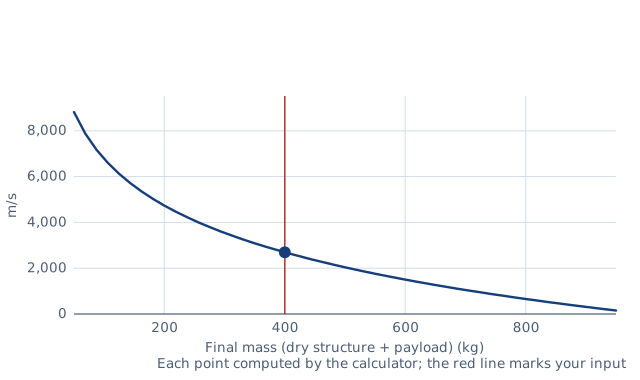
The rocket equation gives the change in speed, delta-v, a rocket can reach by burning its propellant. Multiply the exhaust velocity by the natural logarithm of the mass ratio, the fuelled mass divided by the empty mass. An engine with a specific impulse of 300 s has an exhaust velocity of 2 942 m/s. A rocket that burns 60 % of its mass with it gains 2 696 m/s.
This calculator gives the delta-v from the specific impulse or exhaust velocity and the two masses. It also finds the propellant needed for a delta-v, and adds up the delta-v of a rocket with up to three stages. It is for students, model-rocket fliers, game players and anyone checking a mission budget.
Formulas
Rocket equation and its inverse:
Δv = v_e × ln(m0 / mf)
v_e = Isp × g0
m_p = mf × (e^(Δv / v_e) − 1)
Staging:
Δv_total = Σ v_e,i × ln(m0,i / mf,i)- m0 — initial (fuelled) mass; mf — final mass, dry structure plus payload
- m_p — propellant mass, m0 − mf
- Isp — specific impulse in seconds; g0 = 9.806 65 m/s²
- m0,i — mass at ignition of stage i, including all stages above it and the payload
Assumptions and limitations
- The equation is ideal. Gravity, air drag and steering cost extra delta-v during a launch, so reaching low Earth orbit takes well over the 7.8 km/s orbital speed.
- Specific impulse always converts with standard gravity, 9.806 65 m/s², even for a rocket flying from the Moon or Mars.
- Isp is taken as constant. For a first stage, use a value between the sea-level and vacuum figures.
- Each stage drops its dry mass at burnout. Interstages and fairings belong to the dry mass of the part they leave with.
Worked example
A small rocket has a lift-off mass of 1 000 kg. Its engine has a specific impulse of 300 s, and after the burn 400 kg remain. What delta-v does it achieve?
- Exhaust velocity: 300 × 9.806 65 = 2 942.0 m/s.
- Mass ratio: 1 000 / 400 = 2.5.
- Delta-v: 2 942.0 × ln 2.5 = 2 942.0 × 0.9163 = 2 695.7 m/s.
- Propellant burned: 1 000 − 400 = 600 kg, or 60 % of the lift-off mass.
To reach 3 000 m/s with the same 400 kg final mass, it would need 709.0 kg of propellant.
Common cases
Mass ratio and propellant share of the lift-off mass for a delta-v, by engine type, in a single stage with the ideal rocket equation. Gravity and drag losses are not included, and the specific impulses are typical values for each kind of engine.
| Case | Isp (s) | Delta-v (m/s) | Mass ratio | Propellant share (%) |
|---|---|---|---|---|
| Cold-gas nitrogen thruster, small manoeuvre | 70 | 50 | 1.0756 | 7.0 |
| Hydrazine monopropellant, orbit adjustment | 220 | 200 | 1.0971 | 8.9 |
| Solid rocket motor | 260 | 2,000 | 2.1911 | 54.4 |
| Kerosene and oxygen, sea-level engine | 300 | 3,000 | 2.7724 | 63.9 |
| Kerosene and oxygen, vacuum engine | 340 | 3,000 | 2.4590 | 59.3 |
| Hydrogen and oxygen, upper stage | 450 | 3,000 | 1.9735 | 49.3 |
| Hydrogen and oxygen, 9.4 km/s in one stage | 450 | 9,400 | 8.4155 | 88.1 |
| Ion thruster, long electric burn | 3,000 | 5,000 | 1.1852 | 15.6 |
Every row is worked out by this calculator each time the site is built, and checked for impossible values. Open a case to load its inputs.
Common mistakes
- Taking the propellant mass as the final mass. The final mass is what is left after the burn: structure, engines and payload. A 1 000 kg rocket burning 600 kg at 300 s gains 2 695.7 m/s; entering 600 kg as the final mass gives 1 502.8 m/s.
- Converting Isp with the local gravity. Specific impulse always converts with standard gravity, 9.806 65 m/s², even on Mars. Using 3.71 m/s² turns a 300 s engine into a 1 113 m/s exhaust and cuts the delta-v at a mass ratio of 2.5 from 2 695.7 to 1 019.8 m/s.
- Leaving the upper stages out of a lower stage's mass. Each stage pushes everything above it. In the staging defaults, stage 1 gives 3 567.7 m/s with the upper stage and payload on top. Taken alone, its 22 000 kg falling to 2 000 kg would claim 6 584.3 m/s.
- Using the vacuum Isp for a stage that fires at sea level. Air pressure at the nozzle exit lowers the Isp near the ground. For 3 000 m/s, a 300 s engine needs 63.9 % of the lift-off mass as propellant against 59.3 % at 340 s, so the vacuum figure undersizes the tanks.
- Comparing the ideal delta-v with orbital speed. The equation leaves out gravity, drag and steering losses. A rocket whose ideal delta-v only equals the orbital speed will not reach orbit; add the losses to the budget.
FAQ
What is the rocket equation?
Δv = v_e × ln(m0 / mf). It links the speed a rocket can gain with its exhaust velocity and how much of its mass is propellant.
How do I convert specific impulse to exhaust velocity?
Multiply by standard gravity, 9.806 65 m/s². An Isp of 450 s is an exhaust velocity of 4 413 m/s.
Why do rockets use stages?
Dropping empty tanks and engines means the next stage does not carry dead weight. The two-stage rocket of the staging defaults reaches 7 645 m/s. One stage with the same propellant and structure and a 300 s engine reaches 6 065 m/s.
How much delta-v does it take to reach orbit?
Low Earth orbit is about 7.8 km/s of orbital speed, and gravity and drag add more on the way up. The calculator gives the ideal value only.
What is the mass ratio?
The fuelled mass divided by the empty mass. A mass ratio of 2.718, the number e, gives a delta-v equal to the exhaust velocity.
Does the rocket equation include gravity?
No. It assumes free space. Gravity and drag losses must be added to the mission budget separately.
Related calculators
- Thrust-to-weight ratio — whether the rocket can lift off.
- Speed of sound and Mach number — Mach number during the ascent.
- Drag and lift force — aerodynamic drag in the atmosphere.
- True airspeed — speed through the air at altitude.