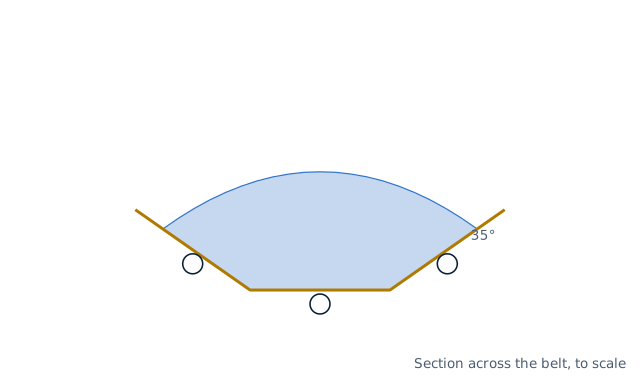
Drawn for the default inputs. It redraws as you change them.
Results are estimates. They do not replace the governing code, class or flag requirements, or a check by a competent person. Report a problem
Introduction
A belt conveyor carries a ribbon of bulk material. Its capacity is the cross-section of that ribbon times the belt speed times the bulk density. The belt speed is the drive pulley's circumference times its rpm. A 36 in belt on 35° idlers carries a load of about 0.99 ft². Driven by a 24 in pulley at 100 rpm, it runs at 628 ft/min and moves about 1 700 t/h of material weighing 100 lb/ft³.
This calculator gives the belt speed, the load cross-section by the CEMA method, and the capacity in m³/h, t/h and short tons per hour. It covers flat belts and troughed belts on three equal rolls. It also gives the power needed to lift the load. It is for plant engineers and designers checking a conveyor or sizing a new one.
Formulas
Belt speed:
v = π × D × n
Load cross-section (CEMA standard area):
c = 0.055 b + 0.9 in            edge distance on each side
b' = b − 2c                     loaded belt width
s = (b' − l) / 2,  W = l + 2 s cos λ
A_base = (l + W) / 2 × s sin λ
A_surcharge = R² (β − sin β cos β),  R = W / (2 sin β)
Capacity and lift power:
Q = (A_base + A_surcharge) × v × ρ
P_lift = Q × g × H
D — drive pulley diameter over lagging; n — pulley speed
b — belt width; l — centre roll length (b/3 by default); λ — trough angle; β — surcharge angle
ρ — bulk density; H — lift height; g = 9.81 m/s²
A flat belt has λ = 0 and carries only the surcharge segment over the loaded width
Assumptions and limitations
The load fills the CEMA standard cross-section: the belt width less a standard edge distance on each side, with a curved top meeting the belt edges at the surcharge angle.
Troughed belts sit on three equal rolls with the gaps ignored. With the default centre roll of a third of the belt width, the area is 2.5 to 3 % above a published idler table. The real roll length, such as 13 in for a 36 in belt, brings it within about 1 %.
The surcharge angle is usually 5° to 15° less than the material's angle of repose. Use the value for your material.
The belt is assumed to be loaded evenly and fully. Surges, incline limits and loading chutes may lower the real capacity.
The power shown only lifts the load. Belt and idler friction, skirtboards, acceleration of the load and drive losses need the full CEMA or ISO 5048 calculation.
Worked example
A 36 in belt runs on 35° idlers with three 13 in rolls. The material has a surcharge angle of 20° and weighs 100 lb/ft³. The drive pulley is 24 in over lagging and turns at 100 rpm. The belt lifts the material 30 ft.
Edge distance: 0.055 × 36 + 0.9 = 2.88 in, so the loaded width is 30.24 in.
Side rolls carry 8.62 in each, so the top width of the trough is 27.12 in.
Cross-section: 99.2 in² in the trough plus 43.5 in² of surcharge, 0.991 ft².
Belt speed: π × 2 ft × 100 = 628.3 ft/min.
Capacity: 0.991 × 628.3 × 60 × 100 lb/ft³ = 3.74 million lb/h, or 1 694 t/h (1 868 short tons per hour).
Power to lift the load: 470.7 kg/s × 9.81 × 9.14 m = 42.2 kW.
The worked example, drawn by the same code as the live drawing above.
FAQ
How do I calculate belt conveyor capacity?
Multiply the load cross-section by the belt speed and the bulk density. The cross-section depends on the belt width, the trough and surcharge angles and the edge distance.
How do I calculate belt speed from the pulley?
Multiply the pulley diameter by π and the rpm. A 24 in pulley at 100 rpm gives 628 ft/min. Measure the diameter over the lagging.
What is the surcharge angle?
The angle the top of the material makes with the belt edge while it moves. It is usually 5° to 15° below the angle of repose.
Why do troughed belts carry more?
The side rolls lift the belt edges, so the belt holds a trapezoid of material under the surcharge. A 36 in belt at 35° carries about 2.6 times the load of a flat belt at the same surcharge.
What is the edge distance?
A strip along each edge left unloaded to prevent spillage. CEMA sets it at 0.055 × belt width + 0.9 in.
Does the lift power give the motor size?
No. It is only the part needed to raise the material. Friction of the belt, idlers and skirts adds to it, so use the full CEMA method for the drive.
Before every release the calculator must reproduce each case below. The note under each case says where the expected answer comes from: a standard, a textbook, a published table, or a hand calculation shown in full.
36 in belt, 35° three equal 13 in rolls, 20° surcharge: 5 946 ft³/h at 100 fpm against 5 886 in the PPI table (within 1.5 %); 0° surcharge 4 133 against 4 058Precision Pulley & Idler idler selection guide, Table 2 (35° troughed belt, 3 equal rolls, 100 fpm)
Default rolls of b/3: 24 in 2 511 vs 2 438, 30 in 4 082 vs 3 975, 36 in 6 032 vs 5 886 ft³/h at 100 fpm (within 3.5 %, on the high side)Precision Pulley & Idler idler selection guide, Table 2
CEMA edge distance 0.055 b + 0.9 in: 2.88 in for a 36 in belt (a published conveyor specifier sheet shows 2.9 in); a flat belt with 20° surcharge carries the circular segment onlyCEMA Belt Conveyors for Bulk Materials, standard edge distance; circular segment area R²(β − sin β cos β)
Speed and capacity: a 24 in pulley at 100 rpm runs π × 2 ft × 100 = 628.3 fpm; 0.9909 ft² × 628.3 fpm × 100 lb/ft³ = 1 868 short tons/h; lifting 30 ft takes ṁ g H = 42.2 kWv = π D n; Q = A v ρ; P = Q g H (hand calculation)
A flat belt with no surcharge, a centre roll as wide as the belt and zero pulley speed are rejectedBehaviour check: warnings and rejected inputs
Worked example of the article: the calculator reproduces 0.991 ft², 628.3 ft/min, 1 694 t/h, 42.2 kW to the digits printedThe worked example on this page, to the digits printed
Assumptions and sources
Assumptions and limits
Belt speed is the pulley circumference times its speed, measured at the pulley surface (include the lagging); belt slip and the belt thickness are neglected.
The load lies on the belt width less the CEMA standard edge distance of 0.055 b + 0.9 in on each side, with a circular top surface meeting the belt edges at the surcharge angle, as in the CEMA standard cross-section.
Troughed belts sit on three equal rolls; the gaps between the rolls are ignored. With the default centre roll of a third of the belt width the area is 2.5 to 3 % above the Precision Pulley & Idler table for 24 to 36 in belts at 20° surcharge (4.6 % at 0°); entering the real roll length (13 in for a 36 in belt) brings it within about 1 %.
The surcharge angle is usually 5° to 15° less than the angle of repose of the material; capacity assumes the belt is evenly and fully loaded to that cross-section.
Power is only the power to lift the load through the given height; belt, idler and skirt friction, accelerating the load and drive losses need the full CEMA or ISO 5048 method and are not included.
Sources
CEMA, Belt Conveyors for Bulk Materials, 7th ed., Chapter 4 (standard edge distance 0.055 b + 0.9 in, standard cross-sectional area of the load on three equal roll idlers, eq. 4.15)
Precision Pulley & Idler, Idler selection guide, Table 2: 35° troughed belt, 3 equal rolls, capacity at 100 fpm (36 in belt, 20° surcharge, 5 886 ft³/h); surcharge angle 5–15° below the angle of repose
Cite this calculator
Papandreou, C. (2026). Belt conveyor speed and capacity calculator. Engineering Bible. https://engineeringbible.com/manufacturing/conveyor-belt/
Embed this calculator on your site
Copy this HTML into your page. The calculator stays free to use and links back here.