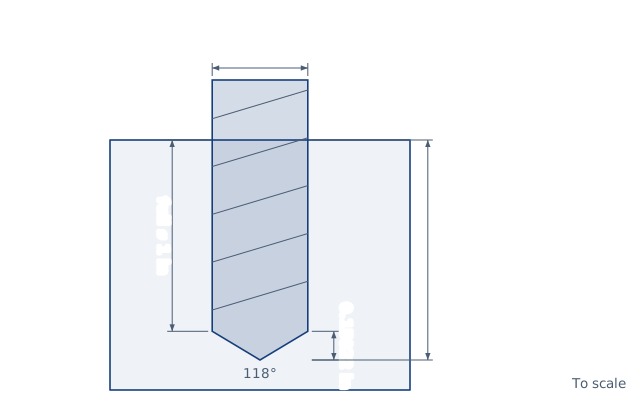
Drawn for the default inputs. It redraws as you change them.
Results are estimates. They do not replace the governing code, class or flag requirements, or a check by a competent person. Report a problem
Introduction
A twist drill ends in a cone. The length of that cone, the point length, is half the diameter divided by the tangent of half the point angle. For the standard 118° point it is 0.3 × the diameter, so a 1/2 in drill has a point 0.150 in long. A blind hole that must be full diameter to 1 in deep needs the drill tip to go to 1.150 in.
This calculator gives the point length for any point angle, the ratio to the diameter, and the depth to program. For a blind hole it adds the point to the full-diameter depth. For a through hole it adds the point and a breakthrough allowance to the thickness. It also lists the point length at the common angles of 90° to 140°. It is for CNC programmers, machinists and designers dimensioning drilled holes.
Formulas
Point length:
L_p = (D / 2) / tan(θ / 2)
Common point angles:
118°:  L_p = 0.3004 D
135°:  L_p = 0.2071 D
140°:  L_p = 0.1820 D
Depth to drill:
blind hole:    tip depth = full-diameter depth + L_p
through hole:  travel = thickness + L_p + breakthrough
D — drill diameter; θ — included point angle
A 180° flat-bottom drill has no point
Assumptions and limitations
The point is treated as a sharp cone. The chisel edge at the centre and any point thinning make the real point slightly shorter.
In a blind hole, the cone of the drill point stays at the bottom. Drawings often give the full-diameter depth and show the 118° cone below it.
A through hole needs the whole point out of the part, plus an allowance so the corners of the drill clear the exit edge cleanly.
For a tapped blind hole, the drilled full-diameter depth must also leave room for the tap's chamfer below the last full thread.
Deep holes may need peck drilling or a deep-hole drill to clear the chips. The page warns above 10 diameters.
Worked example
A 1/2 in drill with a 118° point must give a blind hole that is full diameter to 1 in deep. How deep should the tip go?
Half the point angle: 59°, tan 59° = 1.6643.
Point length: 0.25 / 1.6643 = 0.1502 in.
As a ratio: 0.1502 / 0.5 = 0.3004 of the diameter.
Tip depth: 1 + 0.1502 = 1.1502 in.
With a 135° point, the same drill needs only 0.1036 in more, so the tip goes to 1.1036 in.
The worked example, drawn by the same code as the live drawing above.
FAQ
How do I calculate drill point length?
Divide half the drill diameter by the tangent of half the point angle. For 118°, multiply the diameter by 0.3.
What is the drill point length factor for 135°?
0.207 × the diameter. A 10 mm drill with a 135° point has a point 2.07 mm long.
Why do drills have 118° points?
It is the general-purpose point for twist drills in mild steel and many other materials. Flatter points, such as 135°, suit tough steels, and many solid carbide drills have 140° points.
Should drawing depths include the drill point?
Usually the depth given is the full-diameter depth. The machinist adds the point length to program the tip depth.
How far must the drill go past a through hole?
At least one point length beyond the far face, plus a small allowance so the outer corners clear the edge.
What is a flat-bottom drill?
A drill with a 180° point that leaves a flat bottom. It has no point length to add.
Before every release the calculator must reproduce each case below. The note under each case says where the expected answer comes from: a standard, a textbook, a published table, or a hand calculation shown in full.
Haas: point length 0.30043 D at 118° and 0.207 D at 135°; 140° gives 0.1820 DHaas Automation, Working out drill depth; L = (D/2) / tan(θ/2)
Blind hole: 1/2 in drill at 118°, 1 in full depth: point 0.1502 in, drill to 1.1502 inTip depth = depth + point length (hand calculation)
Metric Haas example basis: a 12 mm drill at 135° adds 0.207 × 12 = 2.485 mm; through 10 mm plate with 1 mm breakthrough travels 13.485 mmHaas Automation 135° multiplier (hand calculation)
Limiting cases: a 180° (flat) drill has no point; a 90° point is half the diameter; the table lists six anglesCone geometry
A point angle below 60°, zero thickness for a through hole and zero diameter are rejected; a hole over 10 D warnsBehaviour check: warnings and rejected inputs
Worked example of the article: the calculator reproduces 0.1502 in, 0.3004, 1.1502 in to the digits printedThe worked example on this page, to the digits printed
Assumptions and sources
Assumptions and limits
The point is a sharp cone with the included point angle of the drill; the chisel edge, thinning and corner chamfers change its length by a small amount.
For a blind hole the full-diameter depth is the depth on the drawing; the drill tip goes one point length deeper, and the cone at the bottom stays in the part.
For a through hole the whole point must leave the part, plus a breakthrough allowance so that the corners clear the exit edge.
Flat-bottom (180°) drills have no point; point angles of 60° to 180° are accepted.
Sources
Haas Automation (UK), Working out drill depth: tip length 0.3 × D for a 118° point and 0.207 × D for 135°, added to the full-diameter depth
Machinery's Handbook Pocket Companion (Industrial Press), Drilling and reaming: typical point angles, 118° for general work
Cite this calculator
Papandreou, C. (2026). Drill point length calculator. Engineering Bible. https://engineeringbible.com/manufacturing/drill-point-length/
Embed this calculator on your site
Copy this HTML into your page. The calculator stays free to use and links back here.