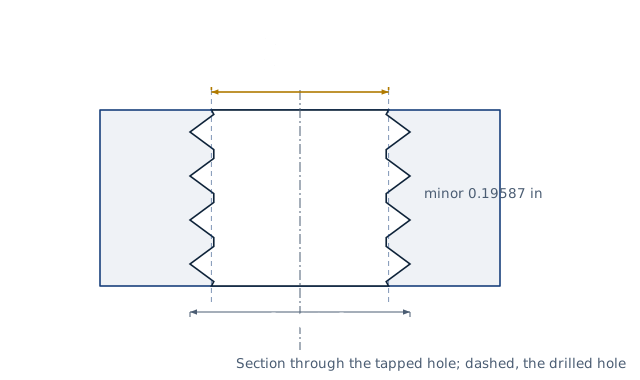
Tap drill for metric coarse and fine and UNC/UNF threads at any percentage of thread, with the nearest standard drill and the basic pitch and minor diameters.
Drawn for the default inputs. It redraws as you change them.
Results are estimates. They do not replace the governing code, class or flag requirements, or a check by a competent person. Report a problem
Introduction
A tap cuts a thread into a drilled hole. The drill size sets how deep the thread is, measured as a percentage of a full thread. The tap makers' formula is: drill = major diameter − 0.01299 × percentage ÷ threads per inch. For 1/4-20 UNC at 75 % thread that gives 0.2013 in, and the nearest standard drill is a #7. In metric, the drill is about the major diameter minus the pitch: 8.5 mm for M10 × 1.5.
This calculator gives the theoretical drill for any percentage of thread, the nearest standard drill and the thread it really gives. It covers ISO metric coarse and fine threads from M2 to M24 and UNC and UNF threads from #4 to 1 in. It also lists the basic pitch and minor diameters of ISO 724 and ASME B1.1, and a table of drills for every size. It is for machinists, toolmakers and designers.
Formulas
Tap drill for a percentage of thread:
drill = D − 1.299 × P × %/100
inch:   drill = D − 0.01299 × % / TPI
metric: drill = D − % × P / 76.98
Thread percentage a drill gives:
% = (D − drill) / (1.299 × P) × 100
Basic dimensions (ISO 724, ASME B1.1):
pitch diameter   d2 = D − 0.649519 × P
minor diameter   D1 = D − 1.082532 × P
D — major (nominal) diameter; P — pitch, P = 1/TPI for inch threads
100 % thread is a double thread depth of 1.299 P, so the basic minor diameter D1 is 83.3 % thread
Assumptions and limitations
The percentage of thread follows the convention of tap makers and Machinery's Handbook. Other charts measure from D1 instead, so their percentages differ.
About 75 % thread is the usual choice for cut taps in steel. A full thread is only slightly stronger but much harder to tap.
The drilled hole should lie in the minor diameter tolerance of the thread class, such as 6H or 2B. This page gives the basic value D1, the bottom of that band.
Drills cut slightly oversize, so the real thread is a little shallower than calculated.
Form taps, also called roll taps, push the metal instead of cutting it. They need a larger hole from the tap maker's chart.
Charts sometimes pick the next smaller standard drill, such as 10.2 mm for M12 instead of 10.3 mm.
Worked example
What drill should be used for a 1/4-20 UNC thread at 75 % thread?
Thread with the #7 drill: (0.25 − 0.201) / (1.299 / 20) = 75.4 % thread.
Basic pitch diameter: 0.25 − 0.649519 / 20 = 0.2175 in. Basic minor diameter: 0.25 − 1.082532 / 20 = 0.1959 in.
The worked example, drawn by the same code as the live drawing above.
FAQ
How do I calculate tap drill size?
For metric coarse threads, subtract the pitch from the diameter: M8 × 1.25 needs 6.8 mm. For inch threads, subtract 0.01299 × 75 ÷ TPI for 75 % thread.
What percentage of thread should I use?
Around 75 % for general work in steel. Use less in tough or hard materials and in long engagements, where tapping torque matters more.
Why not drill for 100 % thread?
The tap would have to cut the whole profile, so tapping torque and the risk of breaking the tap rise sharply. The drill would also be smaller than the basic minor diameter of the nut.
What drill do I need for M6?
5.0 mm, which gives 77 % thread. For the fine thread M6 × 0.75 use 5.3 mm.
What is the difference between UNC and UNF?
UNF has more threads per inch for the same diameter, which gives a larger tensile stress area. UNC is the general-purpose series and is the usual choice in soft materials.
What is the minor diameter of a thread?
The diameter at the root of an external thread, or at the crest of an internal one. The basic minor diameter of the nut is D − 1.0825 P.
Before every release the calculator must reproduce each case below. The note under each case says where the expected answer comes from: a standard, a textbook, a published table, or a hand calculation shown in full.
ASME B1.1: 1/4-20 UNC E 0.2175 / D1 0.1959 in, 1/2-13 UNC 0.4500 / 0.4167 in, 1-8 UNC 0.9188 / 0.8647 inASME B1.1, Table 2 basic pitch and minor diameters
OSG: a 2"-12 tap with a 1.9242" drill gives 70 % thread; 70 % needs 2 − 0.01299 × 70 / 12 = 1.9242 inOSG Tap Drill Size and Pitch Diameter Limit chart, Vol. 3 (2024)
At 75 %: 1/4-20 → #7 (75.4 %), 10-32 → #21, 3/8-16 → 5/16 in, 1/2-13 → 27/64 in, M6 → 5.0 mm, M10 → 8.5 mm (77 %), as on tap drill chartsStandard tap drill charts (OSG, Machinery's Handbook); D − P rule for metric coarse threads
Limiting case: 83.3 % thread drills exactly the basic minor diameter D1; nearest drill to 0.2013 in is #7 not #8D1 = D − 1.082532 P and 100 % = 1.299038 P (ratio 5/6)
High and low percentages warn; an unknown thread and a percentage outside 40–100 % are rejectedBehaviour check: warnings and rejected inputs
Worked example of the article: the calculator reproduces 0.2013 in, 75.4 %, 0.2175 in, 0.1959 in to the digits printedThe worked example on this page, to the digits printed
Assumptions and sources
Assumptions and limits
Percentage of thread follows the tap makers' and Machinery's Handbook convention: drill = D − 0.01299 × % / TPI = D − % × P / 76.98, so 100 % is a double thread depth of 1.299 P and the basic minor diameter D1 corresponds to 83.3 %.
Pitch and minor diameters are the basic values of ISO 724 and ASME B1.1 (d2 = D − 0.649519 P, D1 = D − 1.082532 P); the tolerance class (6H, 2B) adds a small band above D1 that the drilled hole should fall into.
The standard drill is the nearest size in metric jobber drills (0.05 mm steps to 3 mm, 0.1 mm to 13 mm, 0.5 mm to 25 mm) or in fractional, number and letter drills; a drill cuts slightly oversize, so the real thread percentage is a little lower. Published charts sometimes take the next smaller drill (10.2 mm for M12, 12 mm for M14).
About 75 % thread is the usual choice for cut taps in steel: it keeps most of the strength and eases tapping. Form (roll) taps need a larger hole; use the tap maker's chart for them.
Sources
ISO 724:1993 ISO general-purpose metric screw threads — Basic dimensions (d2 = d − 0.6495 P, D1 = d − 1.0825 P); ISO 261 and ISO 262 (pitches)
ASME B1.1-2019 Unified Inch Screw Threads, Table 2 (basic pitch and minor diameters, UNC and UNF series)
OSG USA, Tap Drill Size and Pitch Diameter Limit chart, Vol. 3 (2024): percentage-of-thread formulas (2"-12 with a 1.9242" drill = 70 %)
ASME B94.11M Twist drills (number and letter drill sizes)
Cite this calculator
Papandreou, C. (2026). Tap drill size calculator (metric and UNC/UNF). Engineering Bible. https://engineeringbible.com/manufacturing/tap-drill/
Embed this calculator on your site
Copy this HTML into your page. The calculator stays free to use and links back here.