Vapour pressure at a temperature, or boiling point at a pressure, of water, alcohols, acetone, aromatics, alkanes, ammonia and more by the Antoine equation.
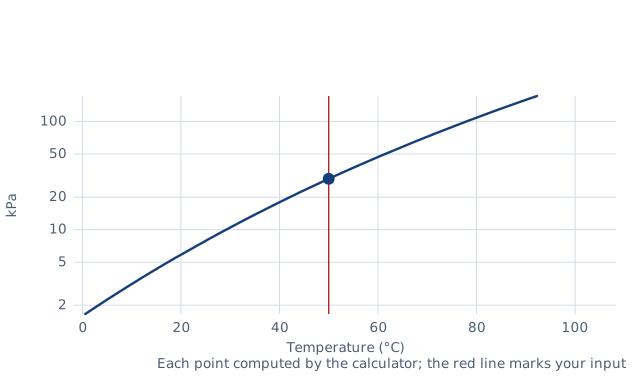
Drawn for the default inputs. It redraws as you change them.
Results are estimates. They do not replace the governing code, class or flag requirements, or a check by a competent person. Report a problem
Introduction
Vapour pressure is the pressure at which a liquid and its vapour are in balance at a given temperature. It rises steeply as the liquid warms, and the liquid boils when its vapour pressure reaches the surrounding pressure. The Antoine equation, log10 P = A − B / (T + C), describes this rise with three constants per liquid. With the NIST constants, ethanol has a vapour pressure of 29.5 kPa at 50 °C and boils at 78.3 °C at sea level.
This calculator gives the vapour pressure of a pure liquid at a temperature, or its boiling point at a pressure, for 14 common fluids. It uses the published constants only inside their temperature range and shows which set it used. For water it also shows the IAPWS-IF97 value for comparison. It is for process engineers, chemists and students checking evaporation, distillation, pump suction and storage conditions.
Formulas
Antoine equation, with the NIST convention of P in bar and T in kelvin:
log10(P / bar) = A − B / (T / K + C)
Boiling point at a pressure, from the same constants:
T = B / (A − log10 P) − C
P — vapour pressure, bar (1 bar = 100 kPa = 14.504 psi)
T — temperature, K (°C + 273.15)
A, B, C — Antoine constants of the liquid, valid over a stated temperature range
Water above 100 °C uses the Dortmund Data Bank constants A = 8.14019, B = 1810.94, C = 244.485 for P in mmHg and T in °C. The calculator converts them to bar and kelvin.
Assumptions and limitations
Antoine constants are fits to measurements. Each set is valid only over its stated temperature range, so the calculator refuses temperatures and pressures outside it.
Most fluids agree with the NIST reference equations of state within 0.3 %. Water above 100 °C is within 1.3 % of IAPWS-IF97, n-butane within 2.6 %, propane within 3 % and ammonia within 5 %.
Where a fluid has two or three ranges, the curve can step by up to 3 % where they meet.
The liquid must be pure. Mixtures need Raoult's law with activity coefficients, and dissolved salts lower the vapour pressure.
Worked example
What is the vapour pressure of ethanol at 50 °C?
Temperature: 50 + 273.15 = 323.15 K, inside the NIST range of 292.77 to 366.63 K.
Constants for that range: A = 5.24677, B = 1598.673, C = −46.424.
The same constants put the normal boiling point at 351.45 K, against the measured 351.44 K.
The worked example, drawn by the same code as the live drawing above.
FAQ
What is the Antoine equation?
An empirical relation between the vapour pressure and temperature of a pure liquid: log10 P = A − B / (T + C). It fits measured data closely, but only over the temperature range its constants were fitted to.
What is the vapour pressure of water at 25 °C?
3.17 kPa, or 23.8 mmHg. At 100 °C it reaches 101.3 kPa, which is why water boils at that temperature at sea level.
How do I find the boiling point at a lower pressure?
Solve the Antoine equation for T at that pressure. Water at 70 kPa, about 3 000 m above sea level, boils at about 90 °C.
Why do Antoine constants come in different units?
Older tables give P in mmHg and T in °C, while NIST uses bar and kelvin. Mixing them gives nonsense, so always check the units with the constants.
Can I use the Antoine equation outside its range?
Not safely. The error grows quickly beyond the fitted range, especially towards the critical point. Use another set of constants or a reference equation of state.
Why does vapour pressure matter for pumps?
A pump cavitates when the suction pressure falls to the liquid's vapour pressure. The NPSH available is the margin above it.
Related calculators
Steam table — exact saturation properties of water by IAPWS-IF97.
Before every release the calculator must reproduce each case below. The note under each case says where the expected answer comes from: a standard, a textbook, a published table, or a hand calculation shown in full.
Ethanol at 50 °C: log10 P = 5.24677 − 1598.673 / 276.726 → 29.49 kPa; normal boiling point 351.45 K (NIST 351.44 K)NIST WebBook Antoine parameters (Ambrose and Sprake 1970), hand calculation; NIST Tboil of ethanol
Water from 0 to 100 °C is within 0.12 % of IAPWS-IF97, and from 120 to 370 °C within 1.3 %IAPWS R7-97(2012) eq. 30 (shared/iapws97.js psat)
Water boils at 100.00 °C at 101.325 kPa and within 0.3 K of IAPWS-IF97 at 50 kPa and 5 barIAPWS-IF97 saturation temperature (eq. 31, shared/iapws97.js tsat)
At 25 °C benzene 12.70, toluene 3.799, n-hexane 20.16, n-pentane 68.35, cyclohexane 13.02, methanol 16.98 kPa within 0.3 %NIST WebBook fluid properties (reference equations of state), saturation pressures interpolated at 298.15 K
At 20 °C ammonia 857 kPa (within 1 %), propane 836 kPa and n-butane 208 kPa (within 0.3 %)NIST WebBook fluid properties (reference equations of state)
Boiling point inverts the vapour pressure in every fluid; ammonia warnsConsistency of T = B / (A − log10 P) − C with the forward equation
Temperatures and pressures outside the tabulated range are refused, not extrapolatedBehaviour check: warnings and rejected inputs
Worked example of the article: the calculator reproduces 29.49 kPa to the digits printedThe worked example on this page, to the digits printed
Assumptions and sources
Assumptions and limits
The Antoine equation log10 P = A − B / (T + C) is a fit to measured vapour pressures; each set of constants is used only inside the temperature range it was fitted to, and the calculator refuses temperatures and pressures outside the tabulated ranges rather than extrapolate.
Constants are those of the NIST Chemistry WebBook (P in bar, T in K); water above 100 °C uses the Dortmund Data Bank set. Where a fluid has more than one range, the calculator switches at the range limits, so the curve can step by up to 3 % there.
Checked against the NIST reference equations of state: most ranges agree within 0.3 %; water above 100 °C within 1.3 % (IAPWS-IF97), n-butane within 2.6 %, propane between 231 and 278 K within 3 % and ammonia within 5 %.
The liquid is pure. Dissolved salts lower the vapour pressure, and a mixture follows Raoult's law only roughly; this page does not treat mixtures.
Sources
NIST Chemistry WebBook, NIST Standard Reference Database 69 (Linstrom and Mallard, eds.), phase-change data: Antoine equation parameters for each fluid
Dortmund Data Bank (DDBST GmbH), Antoine constants of water, 99–374 °C: A = 8.14019, B = 1810.94, C = 244.485 (mmHg, °C)
IAPWS R7-97(2012), Revised Release on the IAPWS Industrial Formulation 1997, eq. 30 (saturation pressure of water, used for the comparison)