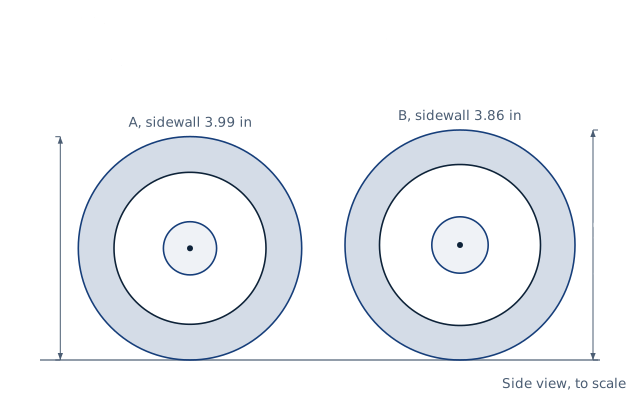
Drawn for the default inputs. It redraws as you change them.
Results are estimates. They do not replace the governing code, class or flag requirements, or a check by a competent person. Report a problem
Introduction
A tire size such as 225/45R17 gives the section width in millimetres, the sidewall height as a percentage of the width, and the rim diameter in inches. To find the overall diameter, multiply the width by the aspect ratio to get the sidewall height. Then add two sidewalls to the rim diameter. For 225/45R17 the sidewall is 101.25 mm and the tire stands 634.3 mm, or 24.97 in, tall.
This calculator reads two size codes and gives the width, sidewall, diameter, circumference and revolutions per mile of each. It then compares them: the diameter difference, and the true speed when the speedometer was set for the original tire. It is for drivers choosing new wheels and tires, and for anyone checking a plus-size fitment.
Formulas
Metric sizes, width W in mm, aspect ratio AR in %, rim d in inches:
H = W × AR / 100
D = d × 25.4 + 2 H        mm
Flotation sizes such as 33x12.50R15 give D and W in inches:
H = (D − d) / 2
Circumference, revolutions and speedometer:
C = π D
revs per mile = 63 360 / (π D[in])
true speed = reading × D_B / D_A
H — sidewall height; D — overall diameter
D_A — the original tire the speedometer was set for; D_B — the new tire
P, LT and ST prefixes, ZR and R construction letters and the load and speed index do not change the size
Assumptions and limitations
The dimensions are the nominal design values of the size code. Real tires of the same size differ slightly between brands and with tread wear.
Revolutions per mile are geometric. Tire makers measure them rolling under load, so their figures are a little higher.
A change in diameter alters the speedometer, the odometer and the inputs to the traction and stability systems. Check the clearance to the body and suspension too.
Codes without an aspect ratio, such as 195R14, are not accepted. Enter the full size.
Worked example
A car on 225/45R17 tires is moving to 245/40R18. How much taller is the new tire, and what is the true speed when the speedometer shows 60 mph?
Old sidewall: 225 × 0.45 = 101.25 mm, or 3.99 in.
Old diameter: 17 × 25.4 + 2 × 101.25 = 634.3 mm, or 24.97 in, and 807.6 revolutions per mile.
New sidewall: 245 × 0.40 = 98.0 mm.
New diameter: 18 × 25.4 + 2 × 98.0 = 653.2 mm, or 25.72 in, and 784.2 revolutions per mile.
Difference: 653.2 / 634.3 − 1 = 2.98 %.
True speed at an indicated 60 mph: 60 × 653.2 / 634.3 = 61.8 mph.
A closer match is 245/40R17 or 225/40R18, depending on the wheel chosen.
The worked example, drawn by the same code as the live drawing above.
FAQ
What do the numbers on a tire mean?
In 225/45R17, 225 is the section width in mm, 45 is the sidewall height as a percentage of the width, R means radial and 17 is the rim diameter in inches.
How do I calculate tire diameter?
Multiply the width by the aspect ratio for the sidewall height. Add twice that to the rim diameter, converting inches to millimetres with 25.4.
How much bigger can I go without affecting the speedometer?
Every change affects it in proportion to the diameter. Keep the new diameter as close to the original as you can; this calculator warns above 3 %.
Will bigger tires make my speedometer read faster or slower?
Slower. With a larger tire the car travels further per turn, so the true speed is higher than the reading.
What does a 33x12.50R15 tire size mean?
It is a flotation size: 33 in tall, 12.5 in wide, for a 15 in rim. The sidewall is (33 − 15) / 2 = 9 in.
What is the difference between P and LT sizes?
P-metric tires are for passenger cars and LT-metric tires for light trucks with heavier loads. The dimensions follow the same formula.
Before every release the calculator must reproduce each case below. The note under each case says where the expected answer comes from: a standard, a textbook, a published table, or a hand calculation shown in full.
225/45R17: sidewall 225 × 0.45 = 101.25 mm, diameter 17 × 25.4 + 2 × 101.25 = 634.3 mm (24.97 in), 807.6 revs per mileISO 4000-1 design overall diameter D = d + 2 S × aspect / 100; hand calculation
225/45R17 to 245/40R18: 653.2 mm against 634.3 mm is 2.98 % taller; 60 mph on the speedometer is 61.8 mph trueHand calculation, true speed = reading × D_B / D_A
Flotation 33x12.50R15: 33 in tall, 12.5 in wide, 9 in sidewall; LT265/75R16 is 31.65 inTire and Rim Association flotation designation (diameter x width R rim, inches); ISO 4000-1 for LT-metric
The parser accepts P and ZR codes, lower case, spaces, dashes and load and speed indexesSize designation formats of ISO 4000-1 and the Tire and Rim Association
Unreadable codes, a missing aspect ratio and impossible sizes are rejected with a plain message; over 3 % warnsBehaviour check: warnings and rejected inputs
Worked example of the article: the calculator reproduces 3.99 in, 24.97 in, 25.72 in, 807.6, 784.2, 2.98 %, 61.8 mph to the digits printedThe worked example on this page, to the digits printed
Assumptions and sources
Assumptions and limits
Dimensions are the nominal design values from the size code: sidewall = section width × aspect ratio, overall diameter = rim diameter + 2 × sidewall (ISO 4000-1, ETRTO); a real tire differs by up to a few percent by brand, tread depth and inflation.
Revolutions per mile and per km are geometric (π × unloaded diameter); tire makers measure them rolling under load, so their published figures are a little higher.
Flotation sizes such as 33x12.50R15 give the overall diameter and section width in inches directly; the sidewall is half the difference between the diameter and the rim.
The speedometer is assumed correct with tire A; with tire B fitted the true speed is the reading × D_B / D_A and the odometer is off by the same percentage.
The section width is the nominal width on the measuring rim; a wider or narrower rim changes the actual width slightly.
Sources
ISO 4000-1:2021 Passenger car tyres and rims — Part 1: Tyres (metric series): size designation and design overall diameter D = d + 2 H, H = S × nominal aspect ratio / 100
ETRTO Standards Manual (European Tyre and Rim Technical Organisation), passenger car tyres, and The Tire and Rim Association Year Book (P-metric, LT-metric and flotation designations)
Cite this calculator
Papandreou, C. (2026). Tire size calculator and comparison. Engineering Bible. https://engineeringbible.com/automotive/tire-size/
Embed this calculator on your site
Copy this HTML into your page. The calculator stays free to use and links back here.