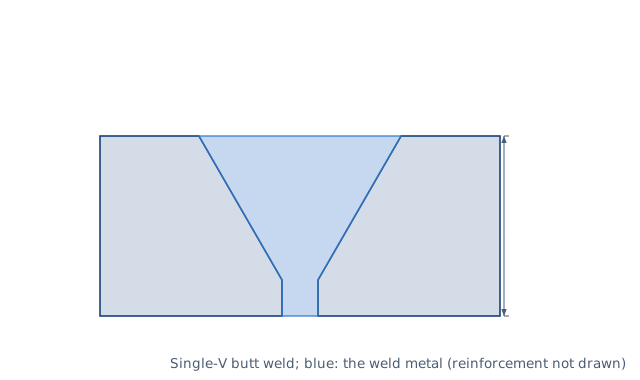
Drawn for the default inputs. It redraws as you change them.
Results are estimates. They do not replace the governing code, class or flag requirements, or a check by a competent person. Report a problem
Introduction
The weld metal in a joint is its cross-section times its length times the density of steel. The filler you buy is more, because part of it never ends up in the weld. Stick electrodes lose their stubs, slag and spatter, so only about 55 % of their mass is deposited. Solid MIG wire deposits about 95 %. A 1/4 in fillet weld holds 0.106 lb of steel per foot.
This calculator gives the cross-section, the deposited mass and the filler metal needed for fillet, single-V and double-V butt welds with root gap and reinforcement. It then works out the number of stick electrodes or the length of wire, and the arc time at the deposition rate of your procedure. It is for welding engineers, estimators and fabricators planning consumables and welding time.
Formulas
Weld cross-section without reinforcement:
fillet (equal legs):   A = z² / 2
single V:              A = g t + (t − f)² tan(α/2)
double V (symmetric):  A = g t + (t − f)² tan(α/2) / 2
Mass, filler and time:
m = A × (1 + r) × L × ρ
filler = m / E
wire length = filler / (ρ π d² / 4)
arc time = m / deposition rate
z — fillet leg; t — plate thickness; g — root gap; f — root face; α — included groove angle
r — reinforcement and convexity allowance; L — weld length; ρ — weld metal density, 7 850 kg/m³ for steel
Fillet welds have equal legs and a flat face. Convexity and the cap on butt welds are added as a percentage of the area.
The double-V joint is symmetric: both sides have the same bevel and depth.
The efficiencies are typical values from a filler maker. Long stub ends, spatter and the welder's habits move them. Measure your own if you buy in bulk.
Wire length assumes a solid wire. Flux-cored wire has less metal per metre, so it needs a longer length for the same mass.
Arc time counts only the time the arc burns. Slag removal, interpass cleaning and handling add to the real welding time.
SAW flux is not included. The flux maker gives its consumption per kilogram of wire.
Worked example
A 10 mm plate has a single-V butt weld 1 m long. The groove has a 60° included angle, a 2 mm root gap and a 2 mm root face. The allowance for the cap is 10 %. It is welded by GMAW with 1.2 mm wire at 3 kg/h.
Weld metal: 62.65 mm² × 1 m × 7 850 kg/m³ = 0.4918 kg.
Filler at 95 %: 0.4918 / 0.95 = 0.5176 kg.
1.2 mm wire weighs 8.88 g/m, so 0.5176 kg is 58.3 m of wire.
Arc time: 0.4918 kg at 3 kg/h is 9.8 min.
The worked example, drawn by the same code as the live drawing above.
FAQ
How do I calculate the weight of weld metal?
Multiply the weld's cross-section by its length and by the density of the metal. Add an allowance for the cap or convexity.
What is deposition efficiency?
The share of the filler that ends up in the weld. The rest is lost as stub ends, slag, spatter and fume.
How many welding rods do I need?
Divide the deposited mass by 0.55 for stick electrodes. Then divide by the mass of one rod, which is the box mass divided by the number of rods.
Why does a double-V joint use less filler?
Each side is bevelled only half the plate depth. The bevel area grows with the square of its depth, so two half-depth bevels hold half the metal of one full-depth bevel.
What is the difference between deposition rate and travel speed?
Deposition rate is the mass of weld metal laid per hour. Travel speed is how fast the torch moves. A larger joint at the same deposition rate needs a slower travel speed.
Does the calculator work for stainless steel or aluminium?
Yes, if you change the density: about 7 900 kg/m³ for austenitic stainless steel and 2 700 kg/m³ for aluminium.
Before every release the calculator must reproduce each case below. The note under each case says where the expected answer comes from: a standard, a textbook, a published table, or a hand calculation shown in full.
Single V, 10 mm, 60°, gap 2, face 2: 20 + 64 tan 30° = 56.95 mm²; +10 % = 62.65 mm²; 0.4918 kg per metre; GMAW 95 % needs 0.5176 kgKobe Steel ABC's of Arc Welding: C = (A1 + A2) × L × G / E / 10 (A in mm², L in m, G = 7.85 g/cm³, E in %)
Wire and arc time: 0.5176 kg of 1.2 mm wire (8.878 g/m) is 58.3 m; 0.4918 kg at 3 kg/h is 9.84 min of arcWire mass per length ρ π d²/4; arc time = deposit / deposition rate (hand calculation)
Fillet: 1/4 in leg is 0.03125 in², 0.106 lb per foot of steel (0.2836 lb/in³); SMAW at 55 % with 0.03 kg rods needs 30 rods for 10 ftA = z²/2 (hand calculation); Kobe Steel E = 55 % for covered electrodes
Double V needs half the bevel metal of a single V of the same plate; a square butt (0° angle) is gap × thickness; efficiencies 55/95/90/100 %Groove geometry (limiting cases); Kobe Steel efficiency list
FCAW warns about wire length; a root face thicker than the plate and a joint with no cross-section are rejectedBehaviour check: warnings and rejected inputs
Worked example of the article: the calculator reproduces 62.65 mm², 0.4918 kg, 0.5176 kg, 58.3 m, 9.8 min to the digits printedThe worked example on this page, to the digits printed
Assumptions and sources
Assumptions and limits
Fillet welds have equal legs and a flat face (area z²/2); groove welds are symmetric, with the bevel measured as the included angle, a root gap and a root face; convexity and cap reinforcement are added as a percentage of the area.
Deposition efficiency is the deposited weld metal divided by the filler consumed: 55 % for covered electrodes (stub ends, slag and spatter), 95 % for solid and metal-cored wire, 90 % for flux-cored wire and 100 % for SAW wire (Kobe Steel); the flux of SAW is extra.
Wire length uses the density of the weld metal for a solid wire; flux-cored wire is lighter per metre, so it needs more length than shown.
Arc time is the deposited mass divided by the deposition rate of the welding procedure; it excludes slag removal, positioning and other non-arc time.
Steel weld metal is taken at 7 850 kg/m³; change the density for stainless steel or aluminium.
Sources
Kobe Steel, The ABC's of Arc Welding — How to calculate welding consumption: C = (A1 + A2) × L × G / E × 1/10, E = 55 % SMAW, 95 % GMAW, 90 % FCAW, 100 % SAW
The Lincoln Electric Company, The Procedure Handbook of Arc Welding, 14th ed.: weld metal weight per foot from joint cross-sections
Cite this calculator
Papandreou, C. (2026). Weld metal and filler consumption calculator. Engineering Bible. https://engineeringbible.com/manufacturing/weld-deposition/
Embed this calculator on your site
Copy this HTML into your page. The calculator stays free to use and links back here.